
The hardest part of choosing fall nails for brown skin tone is rarely finding a color. It is noticing the moment when contrast starts doing too much, or when a pale surface loses its edge against the hand. A useful choice makes the eye pause in one place and then lets it move on; that small difference is what separates a considered manicure from visual noise.
Use a simple two-question filter before committing: does the finish still read when the hand is moving, and does the shape leave enough quiet space around the detail? If both answers are yes, the manicure can carry a strong mood without needing extra decoration. If either answer is no, adjust one variable: length, spacing, or focal placement before changing the entire idea.
Short Rounded Blue-Green Chrome
Short rounded nails give this muted blue-green metallic finish a compact, deliberate outline. The color appears even across the visible nails, and pale highlights travel across the curved surfaces whenever the light changes, so the manicure does not need a motif to feel considered. Because the shape is modest, the reflective finish remains the main decision rather than competing with length or ornament.
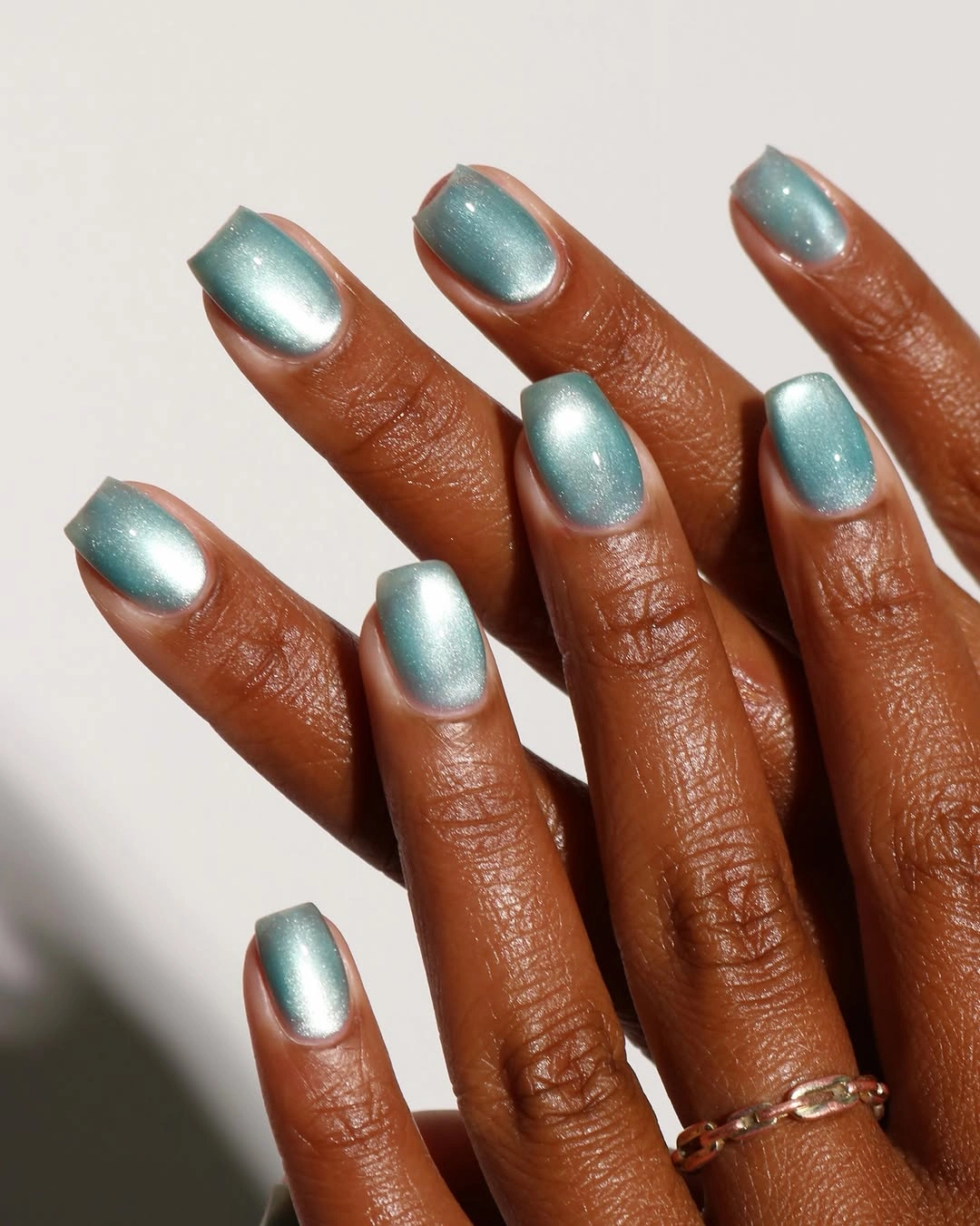
The cool metallic reads clearly against the brown skin because its value shifts from blue-green body color to almost silver-looking highlights. That movement gives one shade more depth than a flat solid cream or pastel would have, while the rounded ends keep the result from becoming visually sharp. If you like the color but want less reflection, a softly glossy blue-green would preserve the contrast without changing the compact proportion.
There is also an honest limit here: a one-color set leaves every shaping decision exposed. Uneven lengths or a broad difference between nail contours would be more noticeable than they would be under dense art, so the design rewards consistent filing. Keep the rest of the styling simple if you want the color to remain the focal point, or move the same metallic to two accent nails when a full reflective finish feels too direct.
Sheer Pink Almonds With Fine Gold Details
Long almond nails soften the pale pink base by giving it a narrow, airy frame. Dark speckles, small gold details, and delicate pale marks appear on separate nails rather than forming one heavy block, which lets the translucent-looking ground remain part of the design. The result feels detailed but not crowded because the decoration is fine enough for the open base to keep its visual importance.
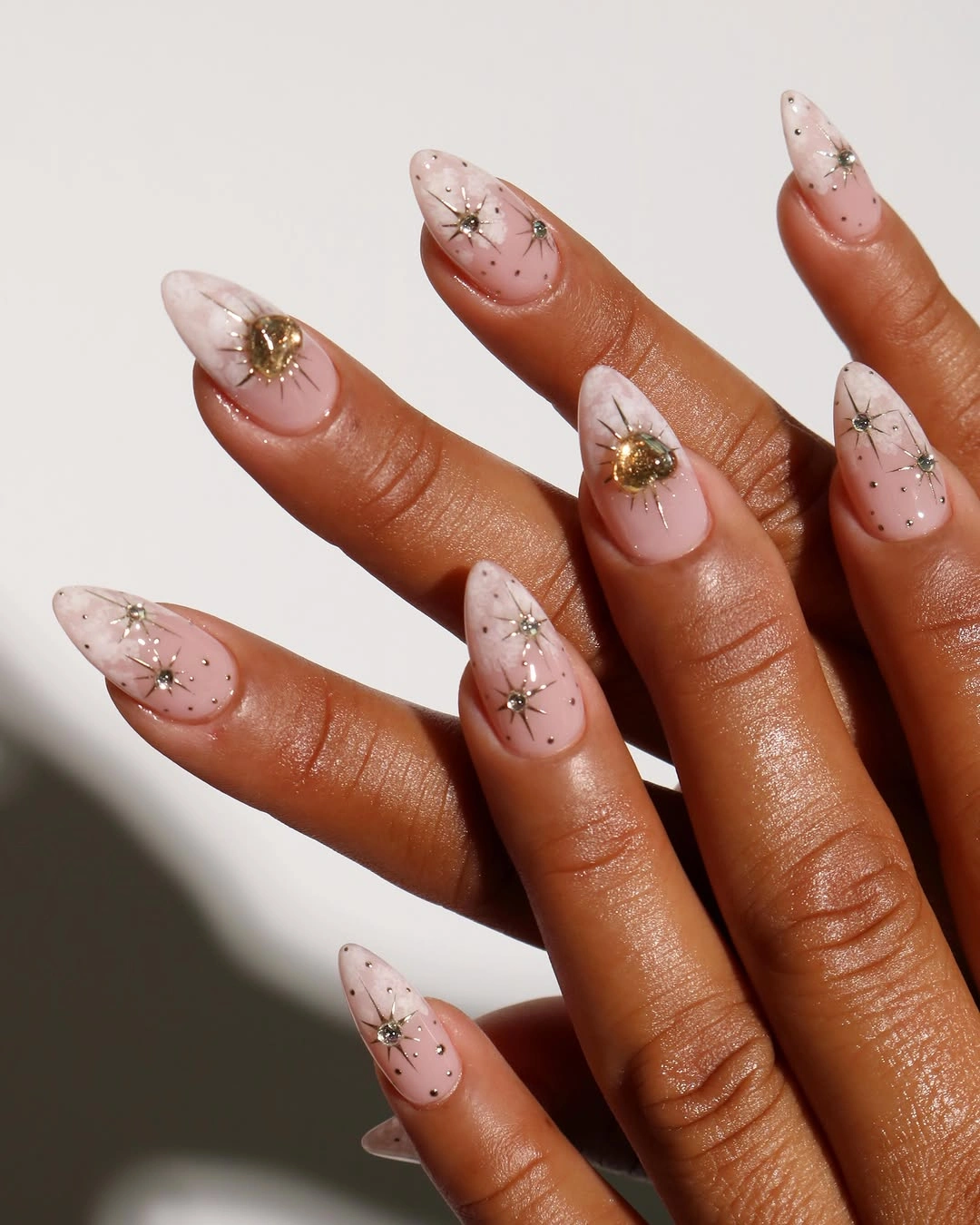
What makes the palette work is the gentle relationship between pink, black, and gold. The dark flecks create definition, the metallic points add warmth, and the pale base prevents either accent from taking over the whole hand. If you want to adapt the idea for a shorter almond shape, retain the gold on one or two nails and replace the speckles with a few spaced dots so the smaller surface does not lose the sense of air.
The long tapered outline is the main tradeoff. Fine details near the tip can draw attention to grow-out or small chips, and the narrow shape has a more directional presence than a rounded one. A plain pink nail beside each decorated accent would lower the density without removing the delicate mood, while a slightly deeper rosy base would give the same marks more contrast on days when pale details disappear in soft light. That spacing principle also matters in the site’s fall nail art ideas.
Graphic Swirls Across Mixed Metallic Accents
These elongated almond nails use several focal languages at once: black circular swirls, pale gray or white grounds, red berry-like marks, and bright metallic flashes. The important structural choice is repetition rather than identical nails. Dark outlines return across separate fingers, so each accent can change while the eye still recognizes one connected manicure instead of a collection of unrelated samples.
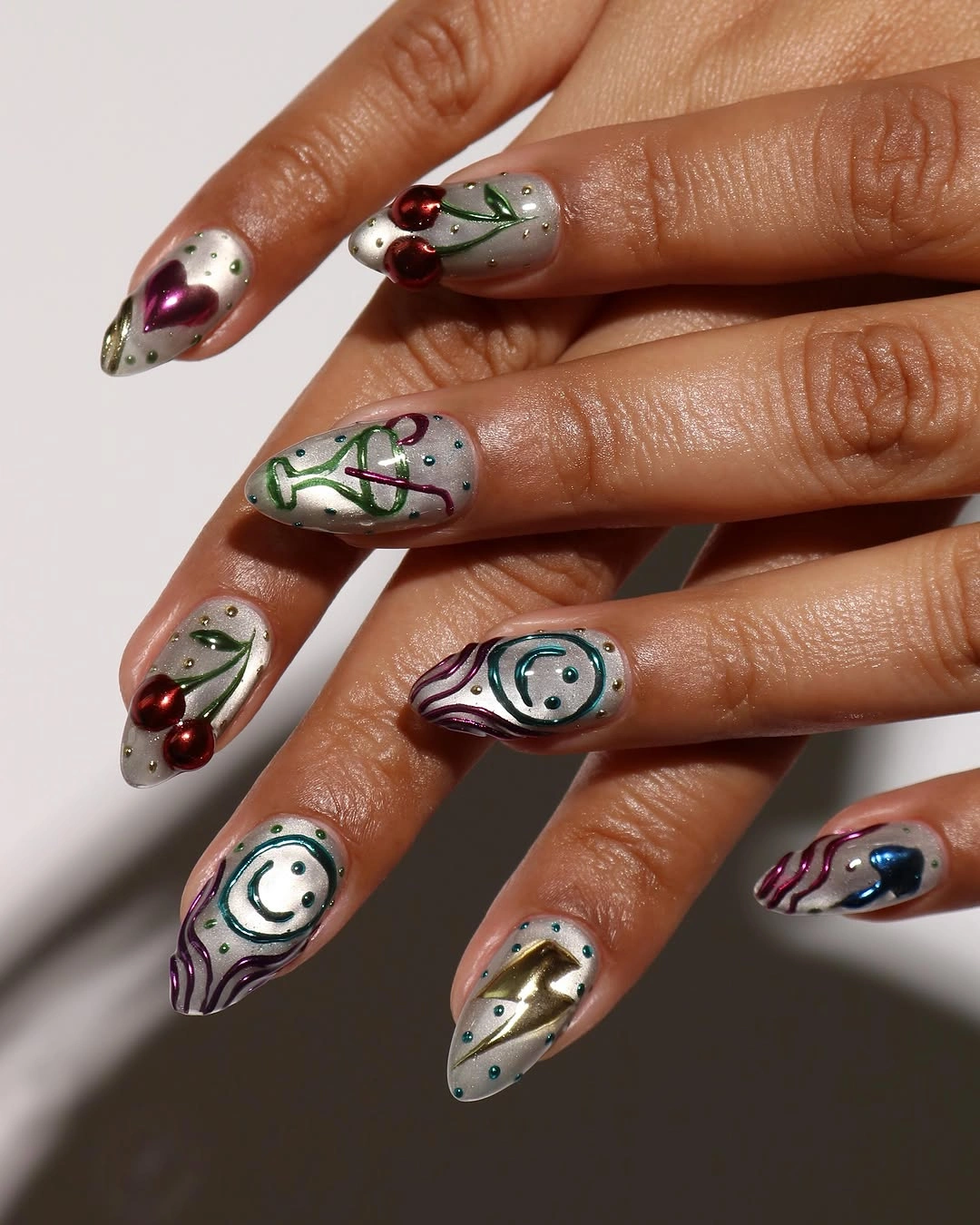
Contrast controls the composition here. The pale grounds create room around the darker spirals, and the red details provide a warm interruption that prevents the silver and white areas from blending together. A useful adaptation is to choose one swirl nail, one red accent, and plain metallic or nude neighbors; the same relationships will remain legible even when the number of motifs is reduced.
Because every nail has a separate point of interest, the design asks for more planning than a single-color manicure. Accessories with many competing colors could make the hands feel visually busy, and an extremely short shape would compress the round line work. Keep the black outline language but widen the spacing on shorter nails, or reserve the most detailed motif for the fingers that naturally sit in the center of the hand. The broader approach is similar to the site’s dark skin nail ideas, where contrast has to stay intentional.
Lime and Black Stiletto Contrast
Very long stiletto nails make the lime, black, and silver palette feel almost architectural. Bright green panels and graphic dark shapes run toward sharp points, while small bead-like details add additional weight around selected nails. The silhouette arrives before the color does, so the first question is not whether the neon is wearable; it is whether the pointed length belongs in the way you use your hands.
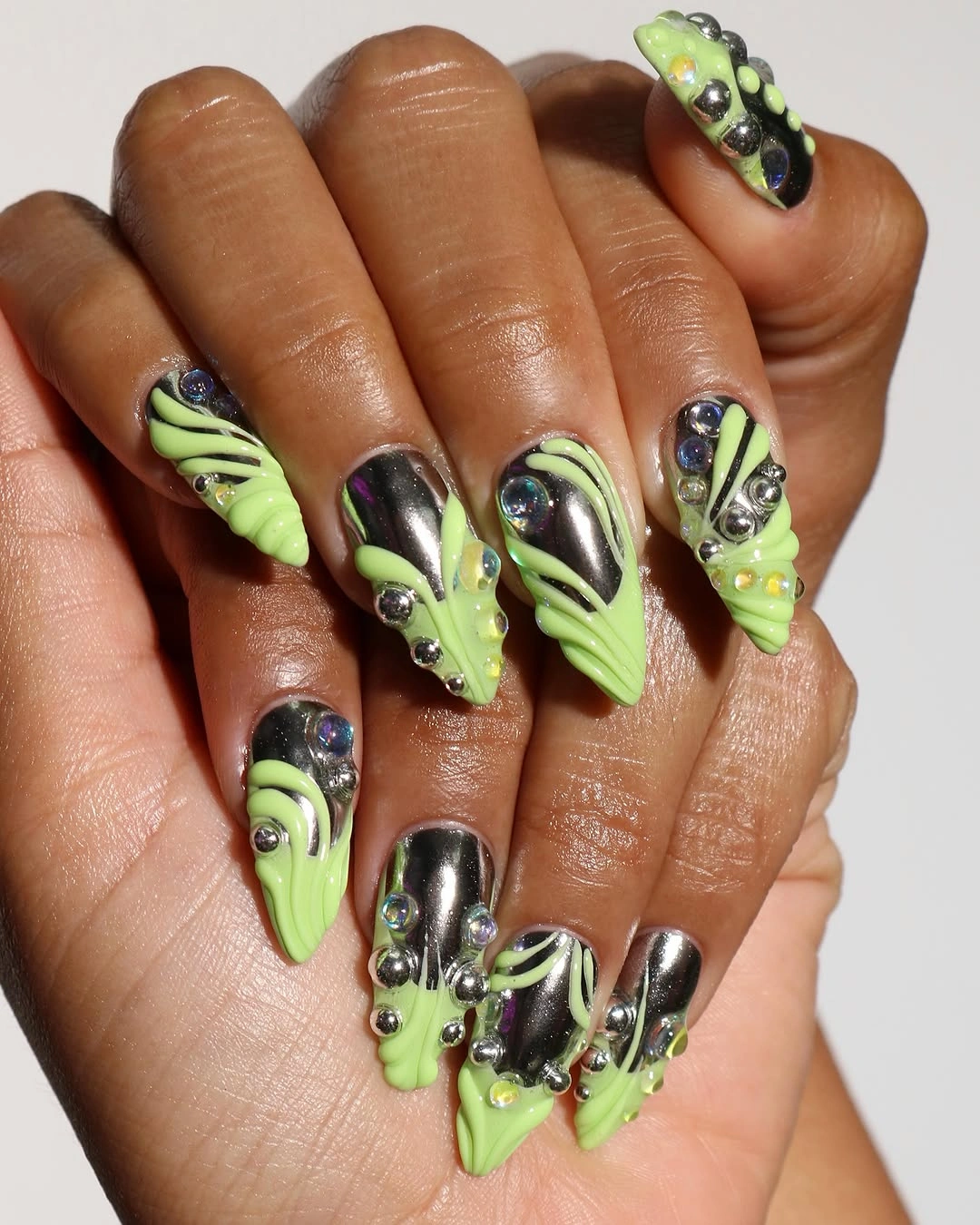
Lime works against black because the two colors divide the surface into clear zones. The green remains bright rather than muddy, and the dark sections give the eye a place to pause between the intense panels. On a medium almond shape, the same palette could be kept to two accent nails with solid lime or black on the others, preserving the contrast while removing some of the visual and practical demand created by the extreme points.
The realistic limitation is density at the tips. Sharp ends, bright color, and small raised-looking elements all attract attention, so adding more jewelry or a loud print to the outfit could compete with the manicure. If you want the drama but need a calmer proportion, shorten the point first and leave the graphic placement intact; reducing every detail at once would erase the reason the design works.
Animal Prints With Zebra and Leopard Rhythm
Long pointed nails alternate pale leopard-like spots, black-and-white zebra lines, warm brown patches, and tiny turquoise accents. The patterns are different, but the repeated neutrals keep them related. Instead of treating the print as one surface-wide texture, notice how each nail gets a distinct scale and direction, allowing the warm brown to support the cool turquoise without turning the set into a single indistinct block.
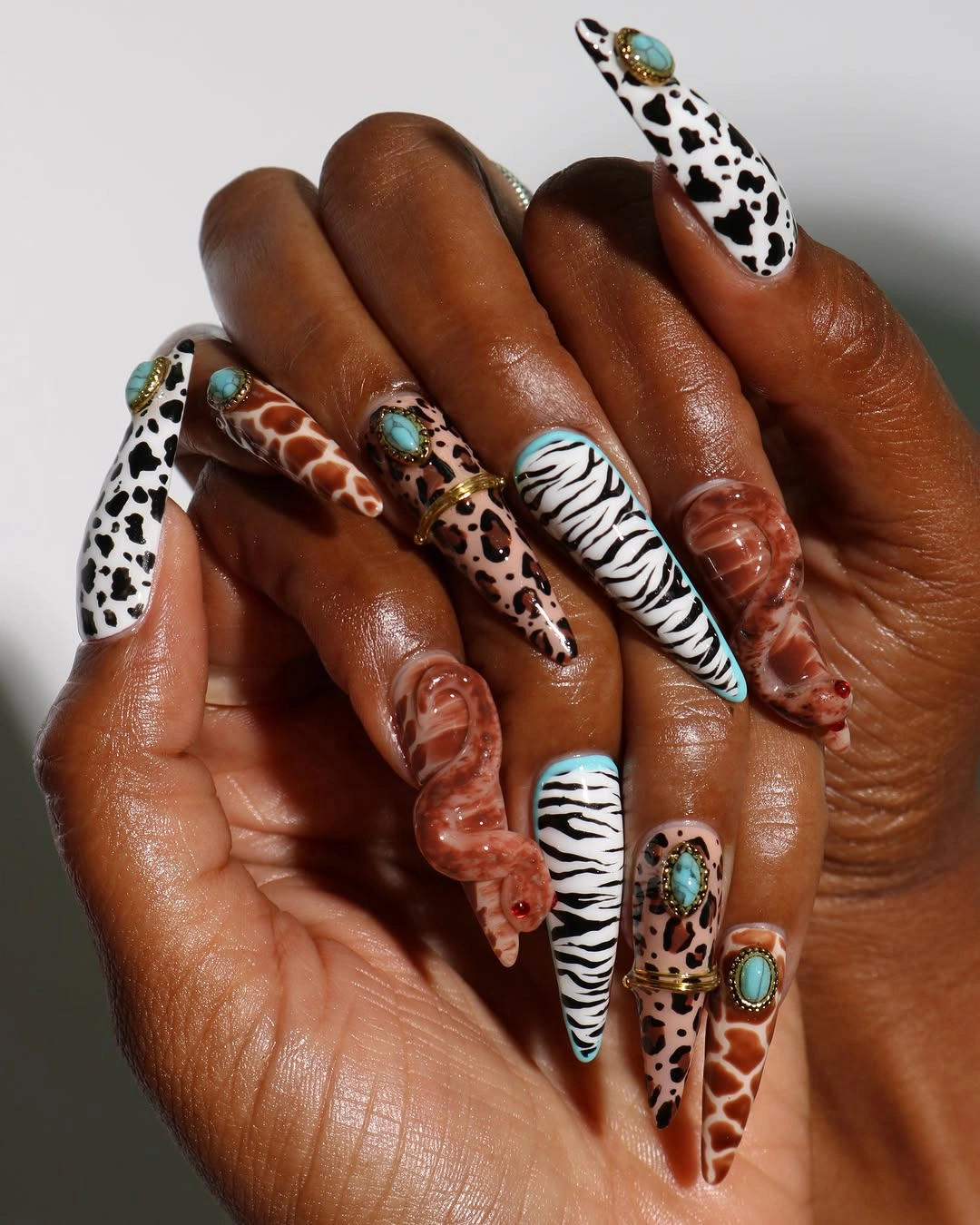
Black and white do the organizing work here. They recur across the zebra-like lines and spotted areas, creating a shared frame around the warmer patches and the occasional turquoise detail. To make the idea easier to wear, keep one print on each hand and use a plain brown or pale neutral beside it; the manicure will still have contrast, but the eye will not need to process a new pattern on every finger.
The pointed length also changes how much pattern is visible. It gives the stripes space to stretch and makes the turquoise feel like a deliberate interruption, yet it can make everyday upkeep more apparent as the tips grow or catch. A medium almond outline would keep the print-led mood with less directional force, while a shorter shape would benefit from larger, simpler spots rather than several tiny pattern changes.
Blush Pink Points With Concentrated Gold
These long blush pink stiletto nails use a quiet base to frame gold ornaments, clear-looking accents, and one stronger multicolor detail near the center of the hand. The pointed outline is consistent, so the eye can notice where the decoration is placed instead of being distracted by changing lengths. The balance comes from concentration: most of the nail remains soft while selected areas carry the shine.
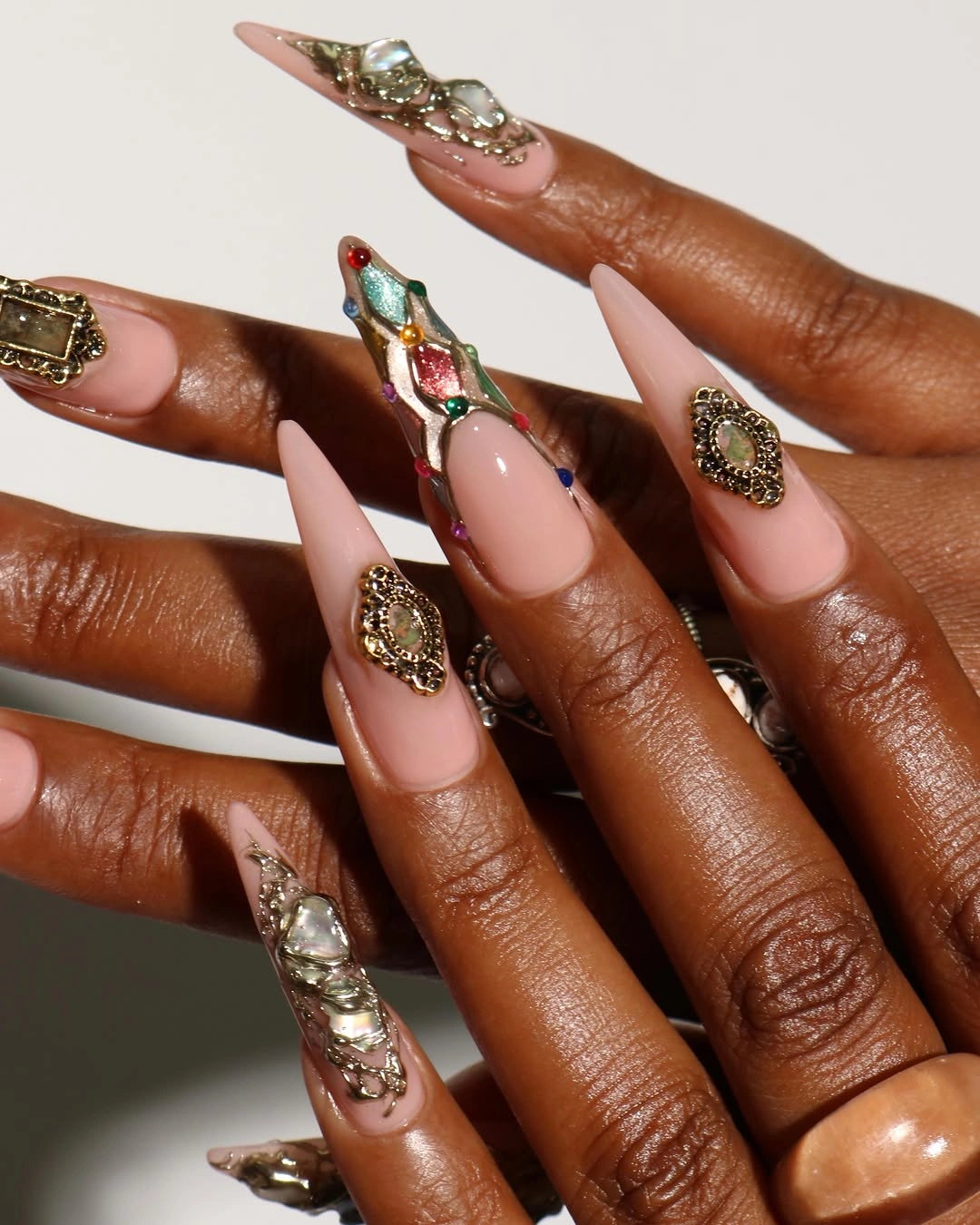
Gold looks warmer against blush pink than it would against a stark white base, and the pale color gives each ornament a defined perimeter. The center detail becomes a focal point because it is surrounded by less active surfaces rather than repeated on every nail. For a more manageable version, place the strongest ornament on two feature nails, keep the remaining nails blush, and let the length be medium almond instead of extremely pointed.
Decoration changes the maintenance conversation even when the base looks delicate. Small pieces near the tip can catch attention as they move, and the long point makes any surface detail feel more prominent than it would on a compact nail. If that is too much commitment, preserve the gold placement but reduce the number of accents; the visual hierarchy will remain clear because the blush base already supplies the calm background.
Buttery Pale Yellow In A Clean Rounded Shape
A creamy pale yellow covers every visible nail in this simple rounded manicure. There is no printed motif competing with the shade, so the shape, spacing, and evenness of the color become the complete visual argument. The moderate length keeps the warm pastel from reading childish or overly decorative, while the soft value creates a lighter seasonal direction beside deeper autumn colors.
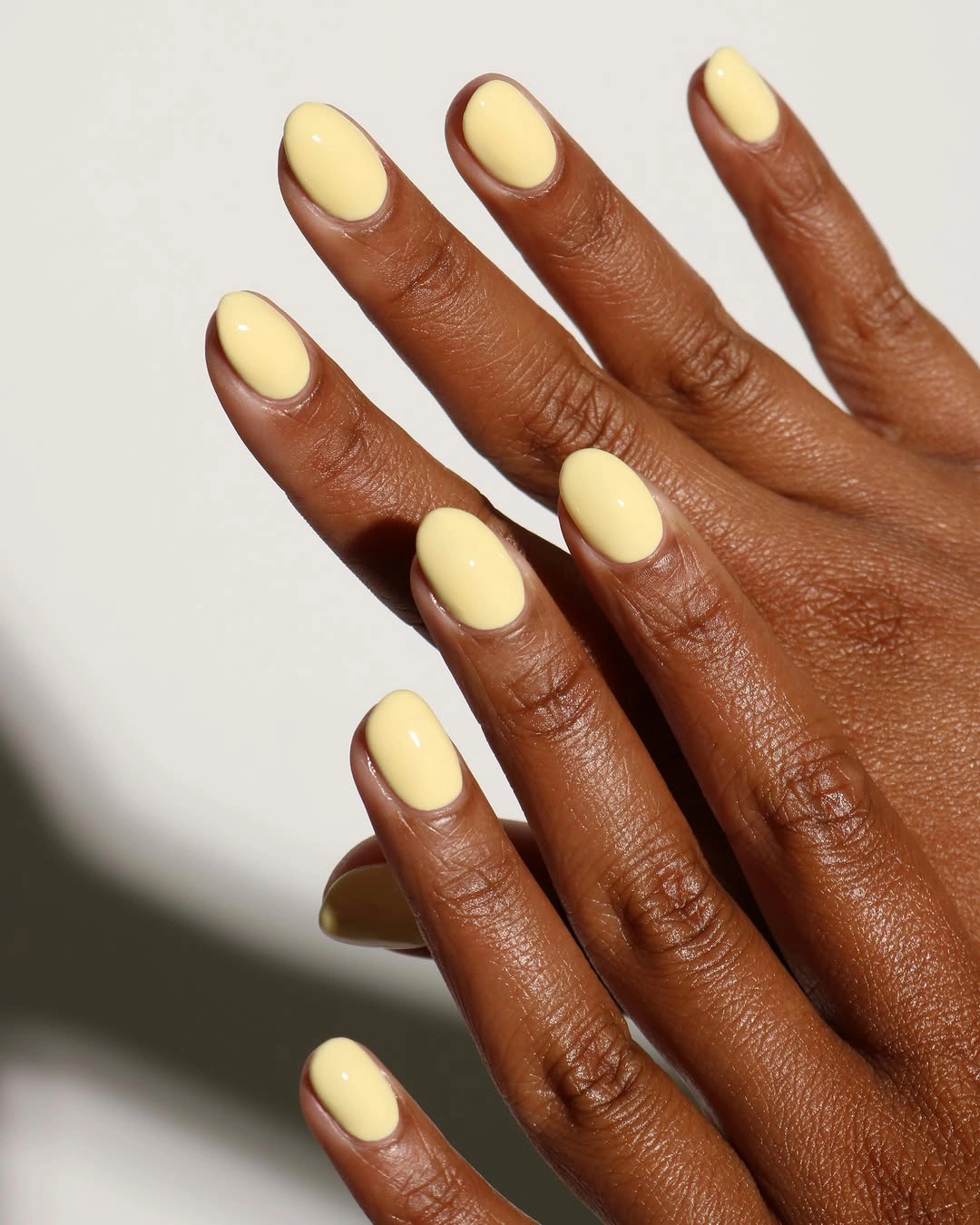
The color works because it is warm enough to feel connected to fall but light enough to contrast gently with brown skin. A glossy-looking surface adds a small shift as the fingers move, yet the finish does not need extra sparkle to stay interesting. If you prefer more separation between the hand and the polish, a slightly richer mustard-leaning version would intensify the same palette while keeping the one-color structure.
Simple does not mean invisible, and that is the practical point of this design. Uneven edges or inconsistent lengths would stand out because there are no accents to redirect attention, so the manicure depends on a clean outline. Use the pale yellow as a full set when you want a calm focal color, or keep it on several nails and introduce one deeper brown accent if a single light shade feels too uniform. The same compact logic appears in the site’s short fall nail designs.
Orange and Cobalt Color-Block Tips
Long stiletto nails combine saturated orange, cobalt blue, turquoise, black borders, and small multicolor dots. The pointed ends give the palette diagonal energy, while the dark lines separate the bright areas so the colors remain individually readable. The design is strongest when viewed as a sequence of blocks and tips rather than as one blended rainbow, with each nail carrying a different proportion of the same high-contrast language.
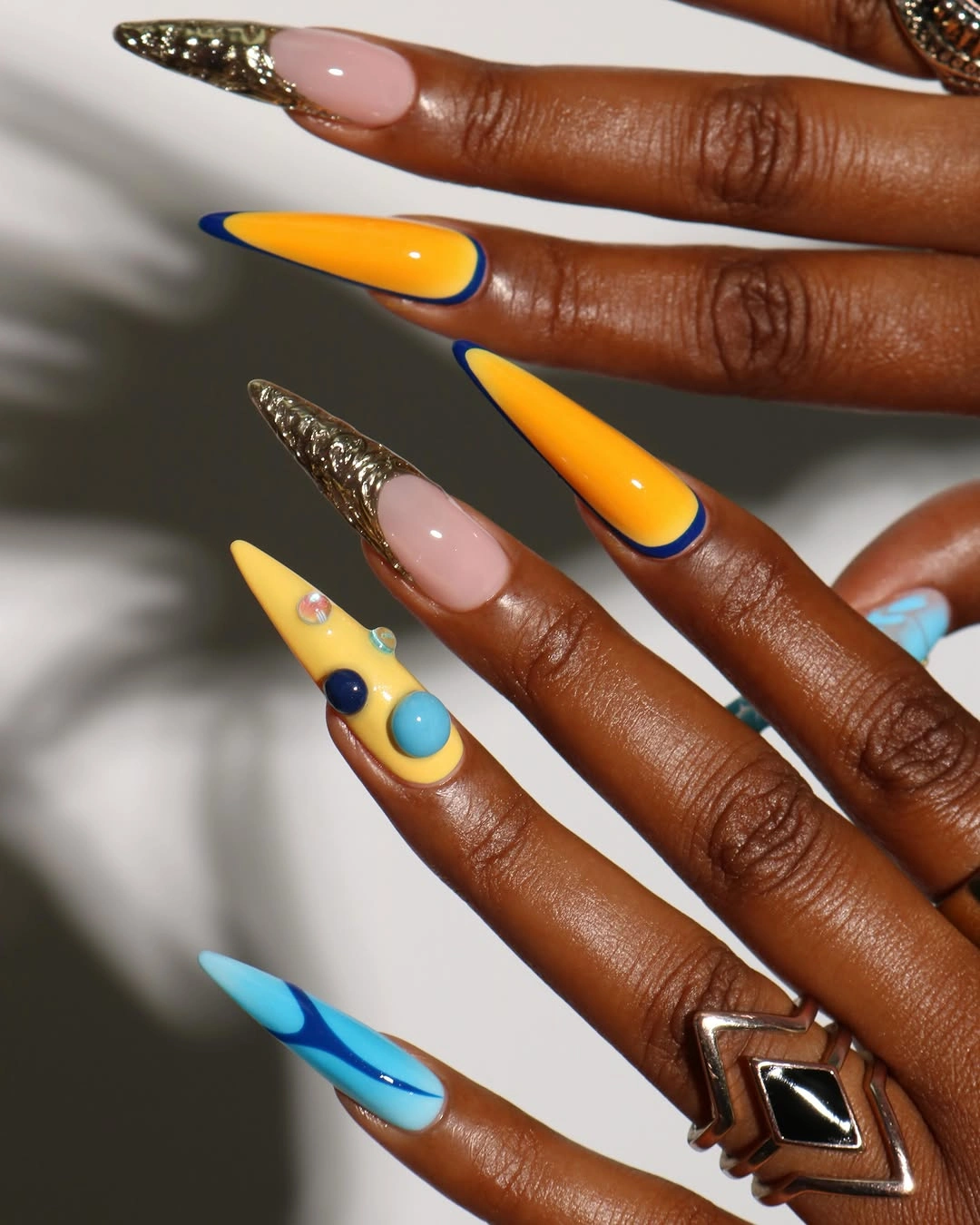
Orange and blue sit far apart visually, so black is useful as a pause between them. Turquoise acts as a bridge because it belongs to the cool side without being as dark as the outline, and the small dots add detail without changing the main structure. A shorter almond adaptation should keep the black separation and reduce the number of bright colors to two or three, otherwise the smaller surface could make the blocks look crowded.
The tradeoff is not just length but coordination. The nails already contain saturated accents in several directions, so clothing with many competing colors could make the entire look feel fragmented. Let one color repeat in an accessory or keep the rest of the styling neutral; if you want less visual commitment, use the graphic arrangement on two feature nails and choose a solid orange or blue for the remaining fingers.
Cobalt Stiletto Nails With Night-Sky Lines
These long cobalt blue stiletto nails stay within one cool color family, shifting from bright blue centers to deep navy areas with fine pale crossing lines and tiny reflective points. The narrow palette makes the design feel more composed than a multicolor set, but the length keeps it dramatic. Shape and tonal depth replace decorative variety, so the eye follows the points and then notices where the blue becomes darker.
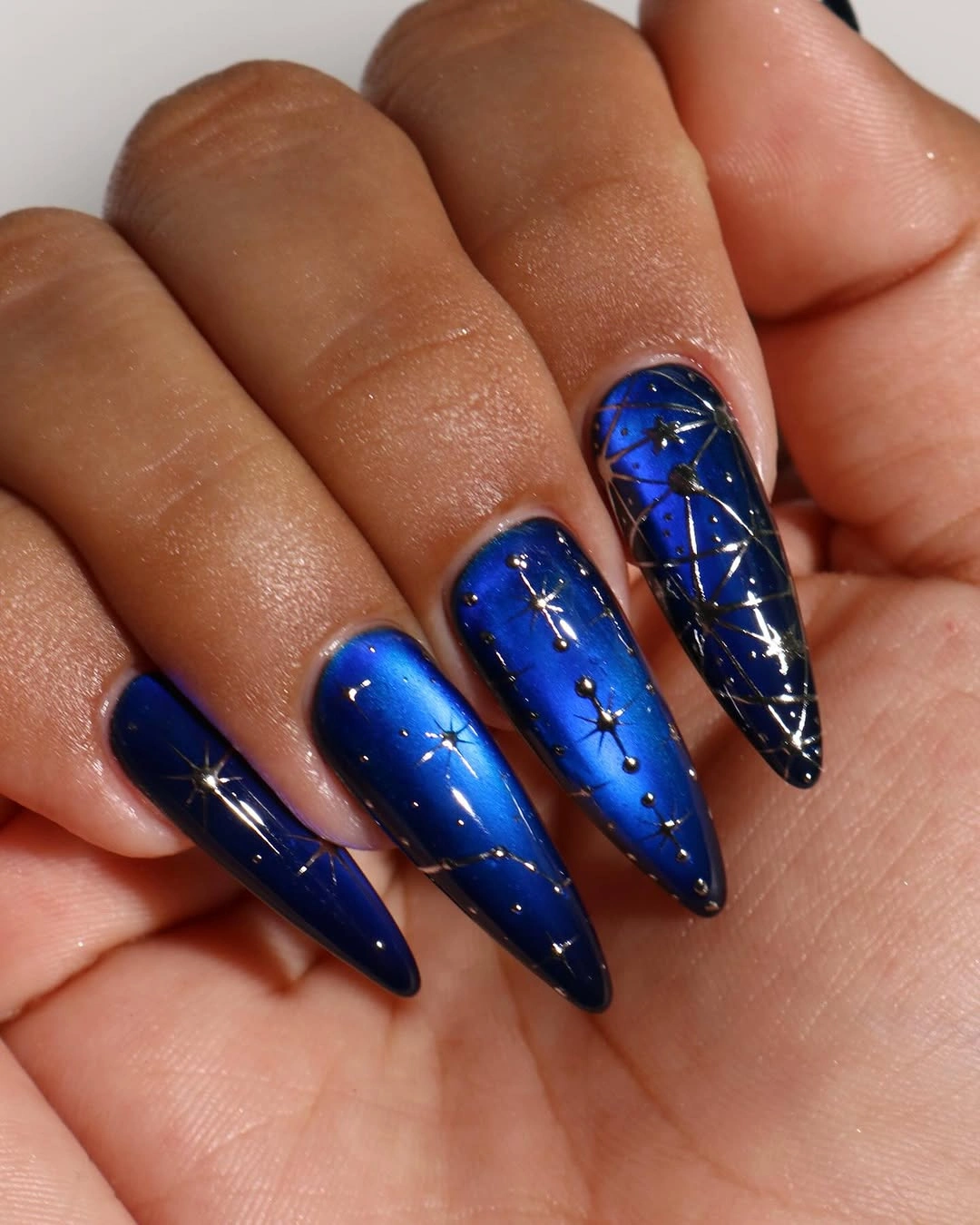
The manicure gains dimension by changing value and line density rather than adding unrelated colors. Brighter blue areas catch the light, while the darker patterned nails give the hand visual depth and make the pale lines easier to read. For a more wearable translation, keep the darkest pattern on two nails and use a medium blue solid on the rest; the tonal conversation will survive even if the points become shorter.
One-color families can be deceptively demanding because every shift must be intentional. If all the blue surfaces are equally bright, the line work may disappear, while too much dark navy can make the hands feel heavier than planned. Keep the most detailed pattern where the nail has enough width, and choose a simpler solid finish on shorter fingers so the design does not lose its visual hierarchy. If you want to compare the reflective side of that decision, the site’s chrome fall nail ideas show how finish can replace extra color.
Milky Nude Pink On Long Almond Nails
Long almond nails painted a milky nude-pink create a clean pause after the sharper graphic designs. The surface appears smooth and evenly reflective, and the outline is long without becoming needle-like, which gives the pale color an elegant vertical line. Nothing else is competing for attention, so the manicure depends on the relationship between the soft base, the tapered width, and the open space around the hand.
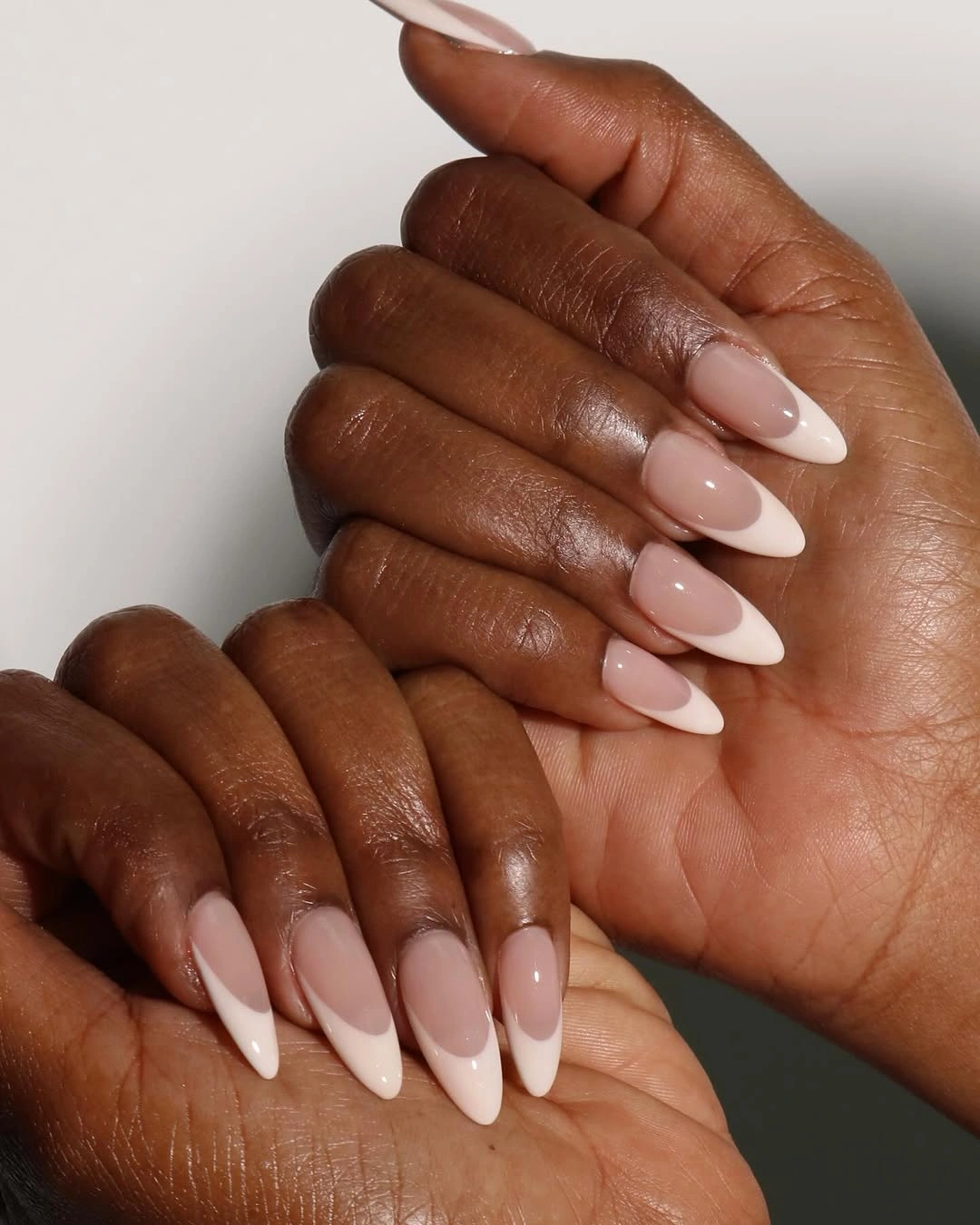
Pale pink keeps the contrast gentle against brown skin while the almond shape adds definition through contour. The effect is not about a named shade or a hidden material; it is about an uninterrupted surface and a consistent silhouette. If you want more seasonal weight, a faintly warmer nude or one deeper accent nail would introduce contrast without turning the clean foundation into a heavily decorated set.
The limitation is that long, even proportions require attention as the nails grow. The smooth base reveals changes in length, and a narrow almond can feel more directional than a rounded edge during everyday tasks. A soft oval or shorter almond would keep the same pale, polished reading, while a single thin line on one nail could add structure if an entirely plain finish feels too quiet. A related comparison is the site’s almond fall designs, where contour does much of the visual work.
Mixed Metals With Warm Red Accents
Long tapered nails alternate gold, silver, bronze, red, and tiny black marks, using reflection as the common thread. Warm and cool metallic-looking areas appear on separate nails, so the palette feels mixed without becoming muddled. The structural idea is distribution: no one metal needs to cover the whole hand when each reflective surface echoes another somewhere else.
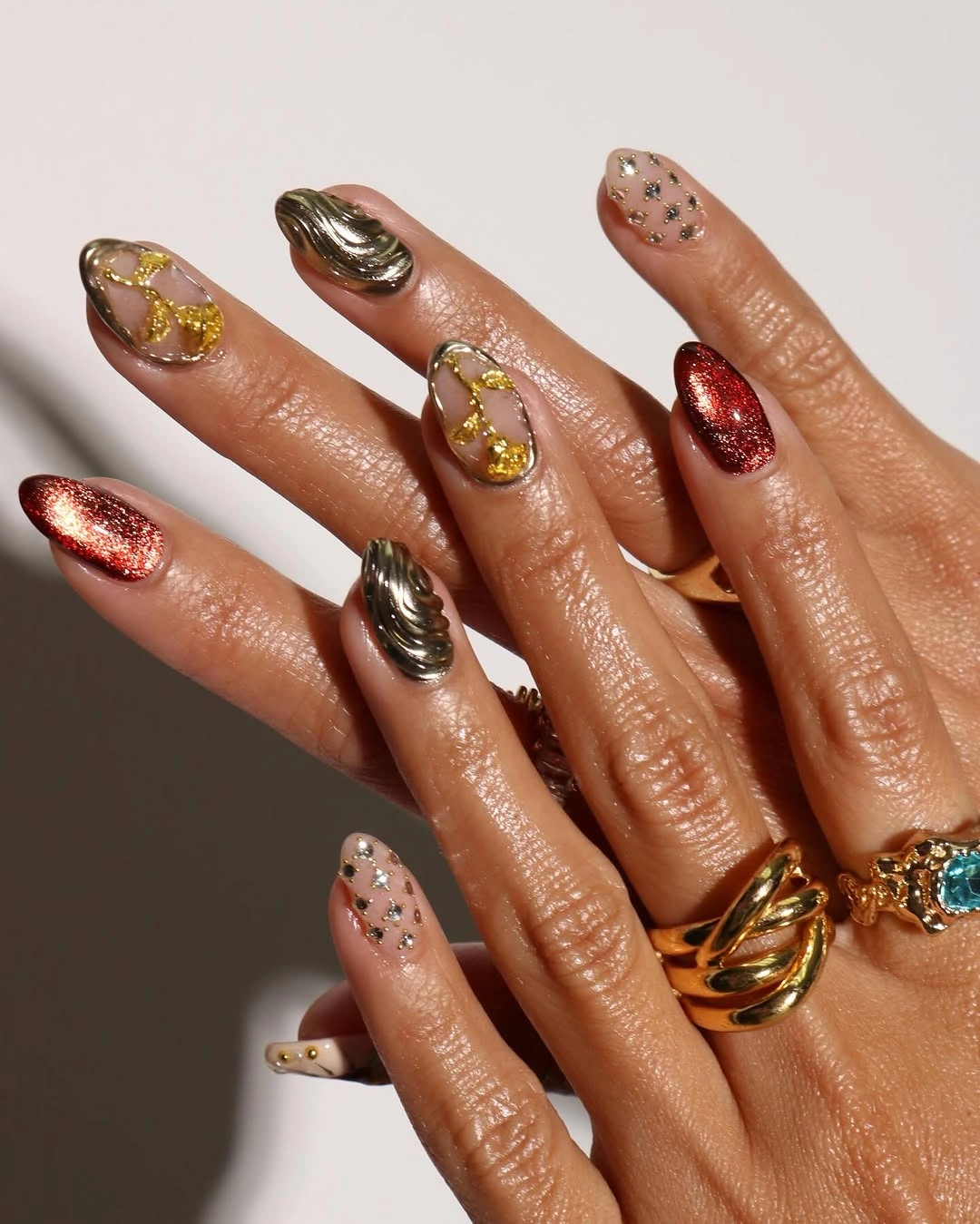
Gold and bronze keep the composition connected to autumn, while silver creates a cooler flash that stops the warm tones from sitting too closely together. Red supplies a solid visual anchor among the reflective areas, and black marks help define small transitions. If you prefer a quieter set, choose one dominant metal, let red appear on one accent nail, and leave the remaining nails a warm nude so the shine has more room.
Mixing metals also changes how accessories will read. Several reflective tones can look intentional with simple jewelry, but extra hardware or colorful stones may compete for the same focal space. The long shape gives the details room, although it can make the overall effect feel more formal than a shorter rounded manicure; reducing length while preserving the metal placement is the most direct way to soften it.
Compact Pink Nails With Green and Gold Micro-Art
Moderately short almond nails use a sheer pink ground with tiny black marks, green curved accents, and small gold details. The design feels intricate because the marks are concentrated and individually placed, yet the compact outline prevents the decoration from becoming an all-over statement. Pink supplies the open space, green gives the manicure a cool seasonal note, and gold adds a small warm point where the eye can rest.
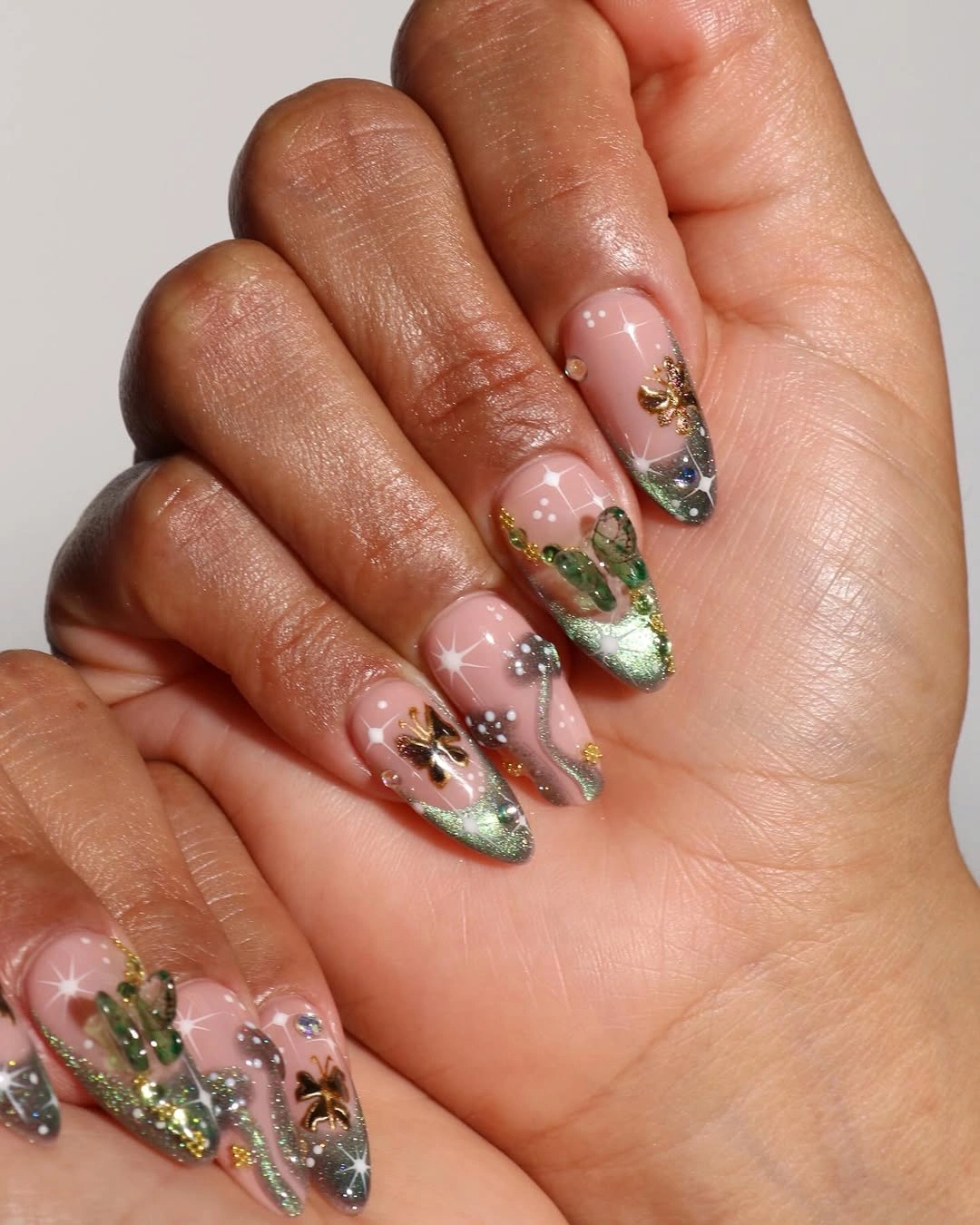
Small surfaces need spacing more than they need more color. The green accents are readable because they do not touch every other detail, while the black marks create just enough definition around the pale base. On an even shorter nail, keep the green and gold on two feature fingers and replace the tiny black marks elsewhere with one simple dot; the idea will remain delicate rather than turning into visual noise.
The practical limit is detail density during grow-out. As the space between the cuticle and the design changes, small marks may lose their original placement faster than a plain color would. A restrained palette helps, and the shorter shape keeps the overall proportion manageable, but the design still rewards careful spacing; if you want lower effort, preserve the pink base and use one green curve per hand instead of repeating every accent.
Vivid Stiletto Panels In Pink Orange and Aqua
These very long pointed nails treat each finger like a separate color panel, moving between bright pink, orange, turquoise, yellow, and narrow white lines. The length makes the palette feel kinetic because every color travels toward a sharp end, while the repeated warm and cool accents stop the manicure from becoming random. The strongest decision is the relationship between panel size and point length.
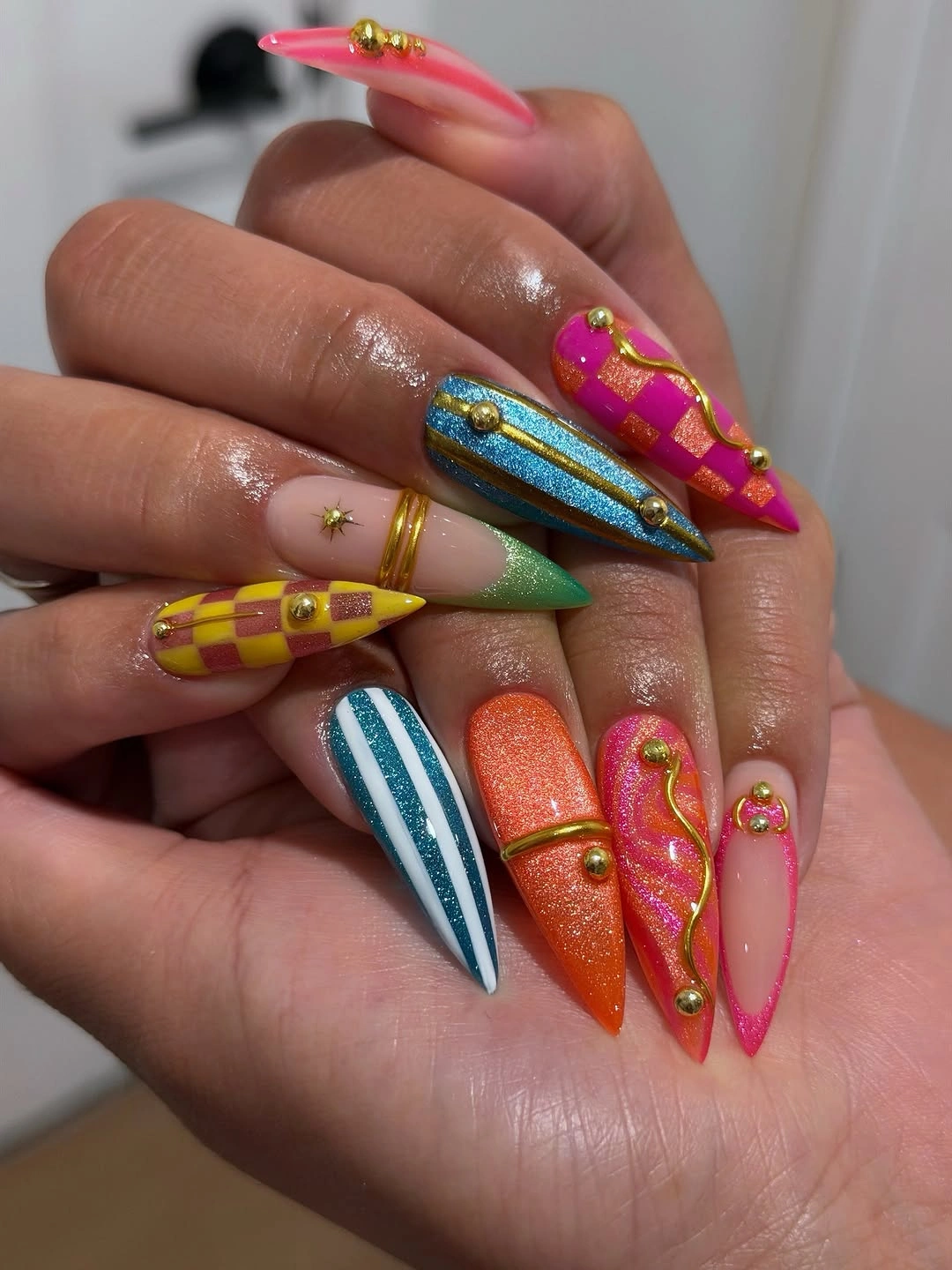
Warm colors bring immediate weight, and turquoise or blue creates the counterpoint that keeps the composition from leaning entirely orange and pink. Small metallic-looking points add sparkle but do not replace the larger color blocks, which is why the design remains readable at a glance. A medium almond version should keep three colors at most and give each one a broader, calmer area instead of shrinking every detail to fit.
Maximal color asks for editing outside the manicure. A patterned outfit, large rings, and many bright accessories could make the hand look disconnected from the rest of the styling, especially with tips this long. If the full set feels too intense, select two feature nails for the multicolor treatment and use a quiet nude or one solid coordinating shade elsewhere; the contrast will remain, but the visual weight will be easier to carry.
Pink Tapered Tips With Black and White Lines
Long pink nails use black-and-white feather-like or zebra-like lines as accents over a soft base. The pale pink is important because it lowers the force of the dark graphic marks, and the tapered outline gives the lines a natural vertical direction. Instead of covering every surface with contrast, the design lets the motif occupy a controlled portion of each nail.
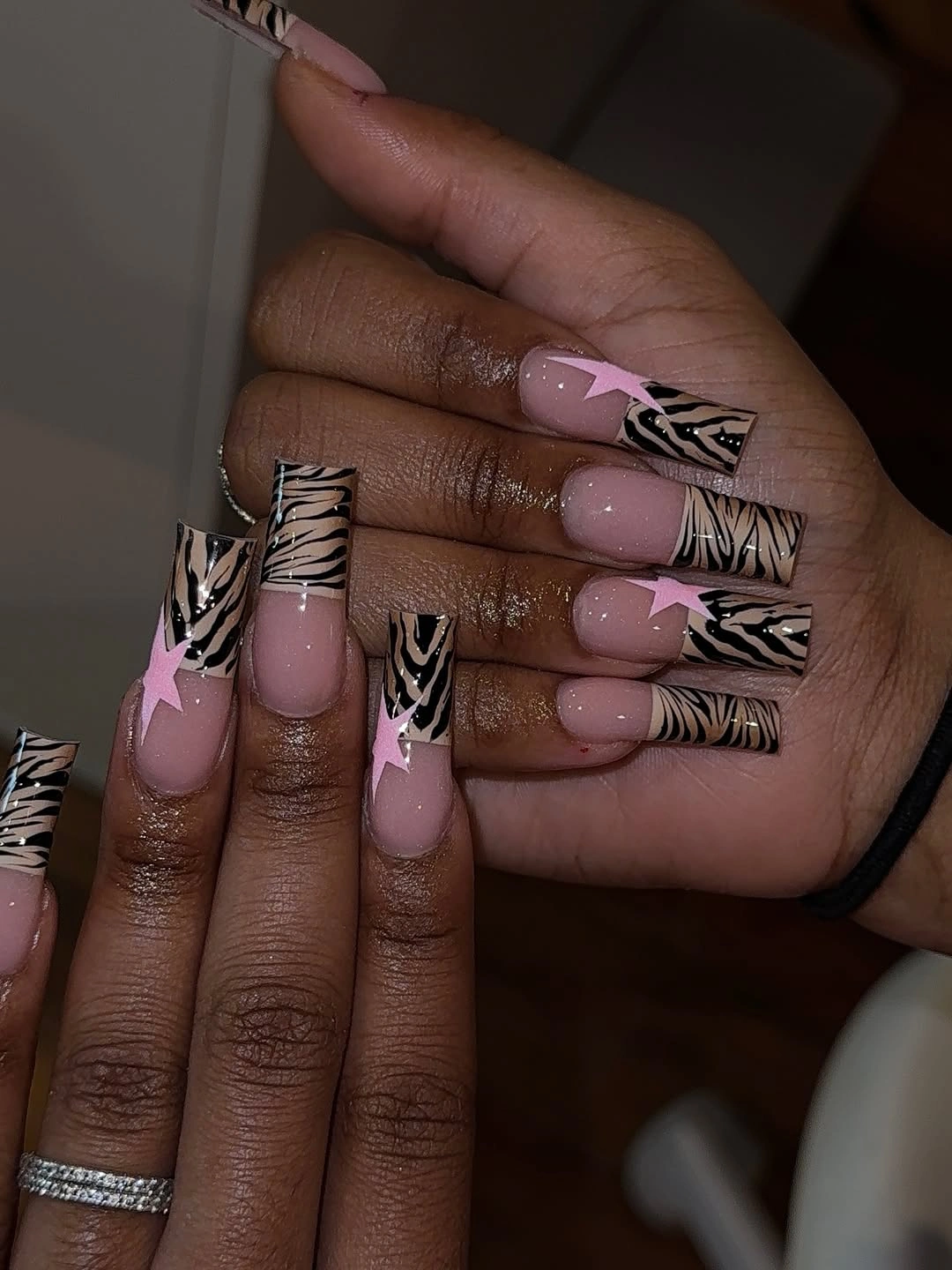
Black and white create a strong edge against the pink, yet the pale ground keeps the result lighter than a black-based print. The line accents are most effective when their scale remains narrow and their placement follows the nail rather than cutting across the entire width. To adapt the look, use one patterned nail per hand and keep the others pink, or make the graphic section a small tip so the base remains the dominant field.
The long silhouette gives the lines room to move, but it also makes the design more noticeable in every gesture. If your style is usually quiet, a shorter almond with a wider but simpler motif may feel more natural than trying to reproduce fine detail on a compact surface. The key is to preserve the pink-to-graphic contrast; removing every dark accent would leave a different manicure rather than a calmer version of this one.
Ornamental Multicolor Stiletto Panels
Very long pointed nails combine red, orange, blue, turquoise, and gold-toned decoration, with flower-like and ornamental details assigned to different fingers. The set is maximalist, but it is not without structure: colors recur across the hand, and the long points create a shared vertical frame. The eye moves from one accent to the next because no single motif is forced to explain the entire manicure.
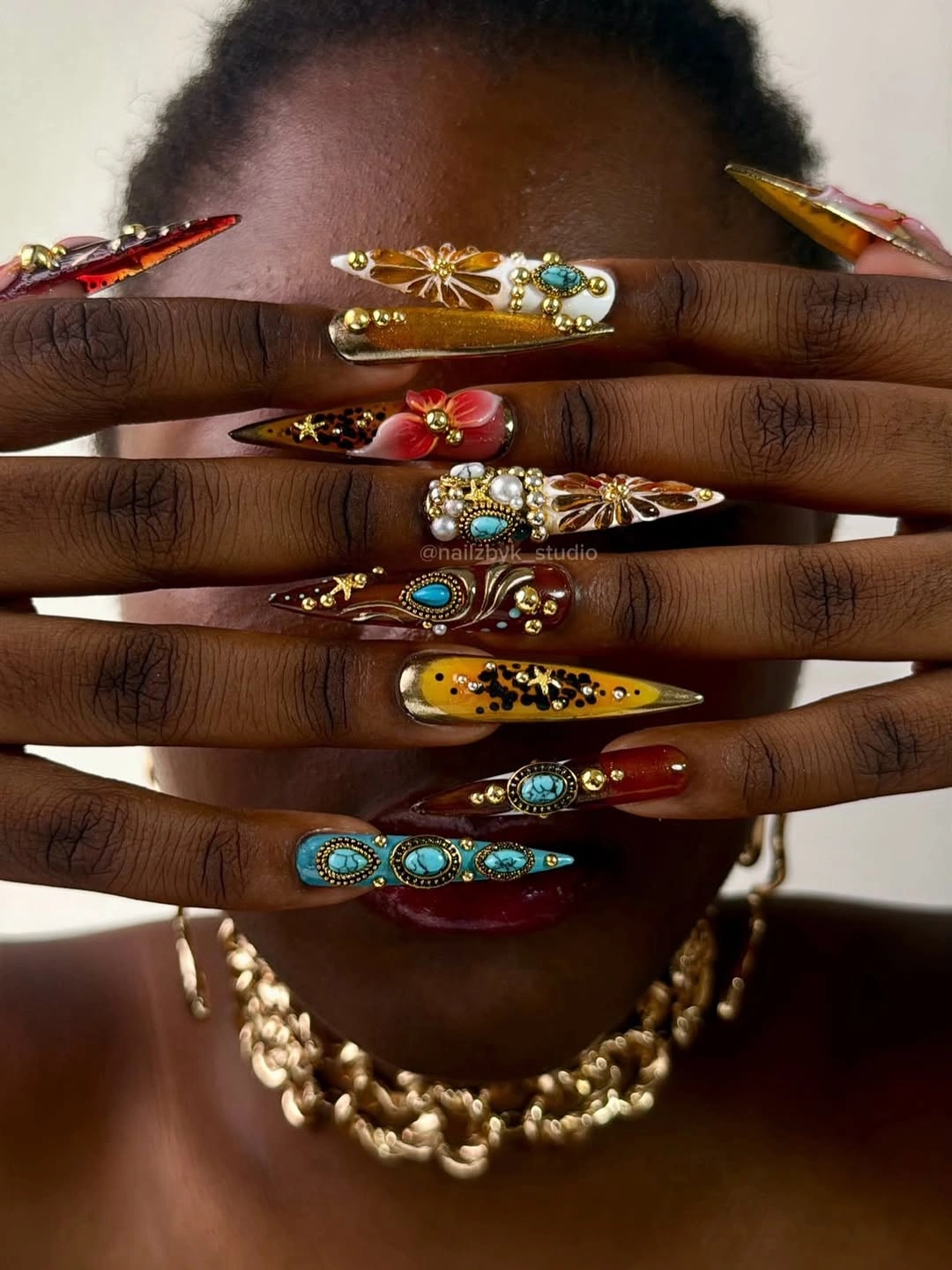
The warm colors give the manicure autumn weight, while turquoise and blue prevent the reds and oranges from merging into one hot field. Gold details act as small bridges between the different panels, especially where the base colors change quickly. A practical edit would keep three colors and two feature nails, then use a solid red, nude, or turquoise on the rest; the palette would still feel connected without asking every finger to carry an ornament.
With so much detail, the honest tradeoff is visual effort rather than a claim about durability. The long points and many accents naturally draw attention, and small decorations can be harder to keep visually quiet as they wear or shift. If the full composition feels too dense, reduce motif count before reducing contrast; a few clearly placed ornaments will communicate the original idea better than many tiny marks squeezed onto shorter nails.
Rainbow Stripes On Extreme Points
Extremely long stiletto nails turn rainbow stripes into elongated graphic panels. Pink, yellow, blue, and orange bands travel along the points, with wavy edges and small decorative details adding movement against darker sections. The length is not incidental here; it stretches simple stripes into a dramatic rhythm, so reducing the point is the first adaptation to consider if the color story is what you want to keep.
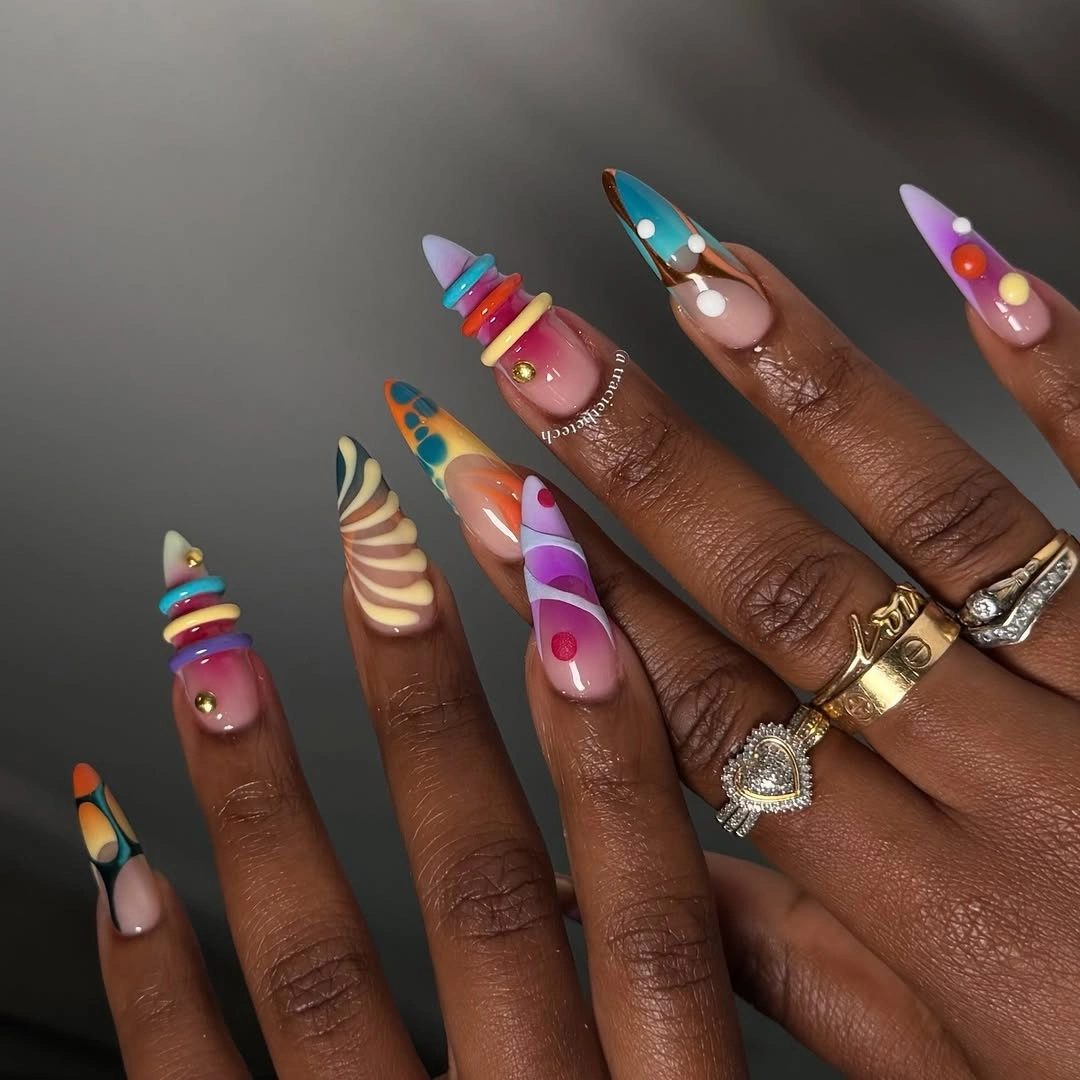
The stripes remain coherent because the bright colors repeat in a similar order and the dark ground gives them a firm boundary. Each band is easier to read than a blended rainbow would be, and the alternating curves keep the hand from looking rigid. On medium almond nails, use the stripe idea on two accents and choose one solid color from the palette for the remaining fingers; the motion will remain visible without compressing every band.
This is a design where proportion controls the entire impression. On a short nail, very thin rainbow lines could disappear, while on a long point the same lines become the central event and may compete with jewelry. Keep the bands broader and fewer if you shorten the shape, and let the outline stay clean; the visual rhythm matters more than copying every tiny decorative mark.
Pastel Pink Nails With Turquoise Edges
Long pale pink nails use turquoise tips, fine white sweeping motifs, and tiny dark details to create a light but defined contrast. The pink base stays soft, while the cool edge color gives the fingers a crisp boundary that the pale ground alone would not provide. The shape is elongated, yet the restrained palette keeps the manicure airy rather than heavy.
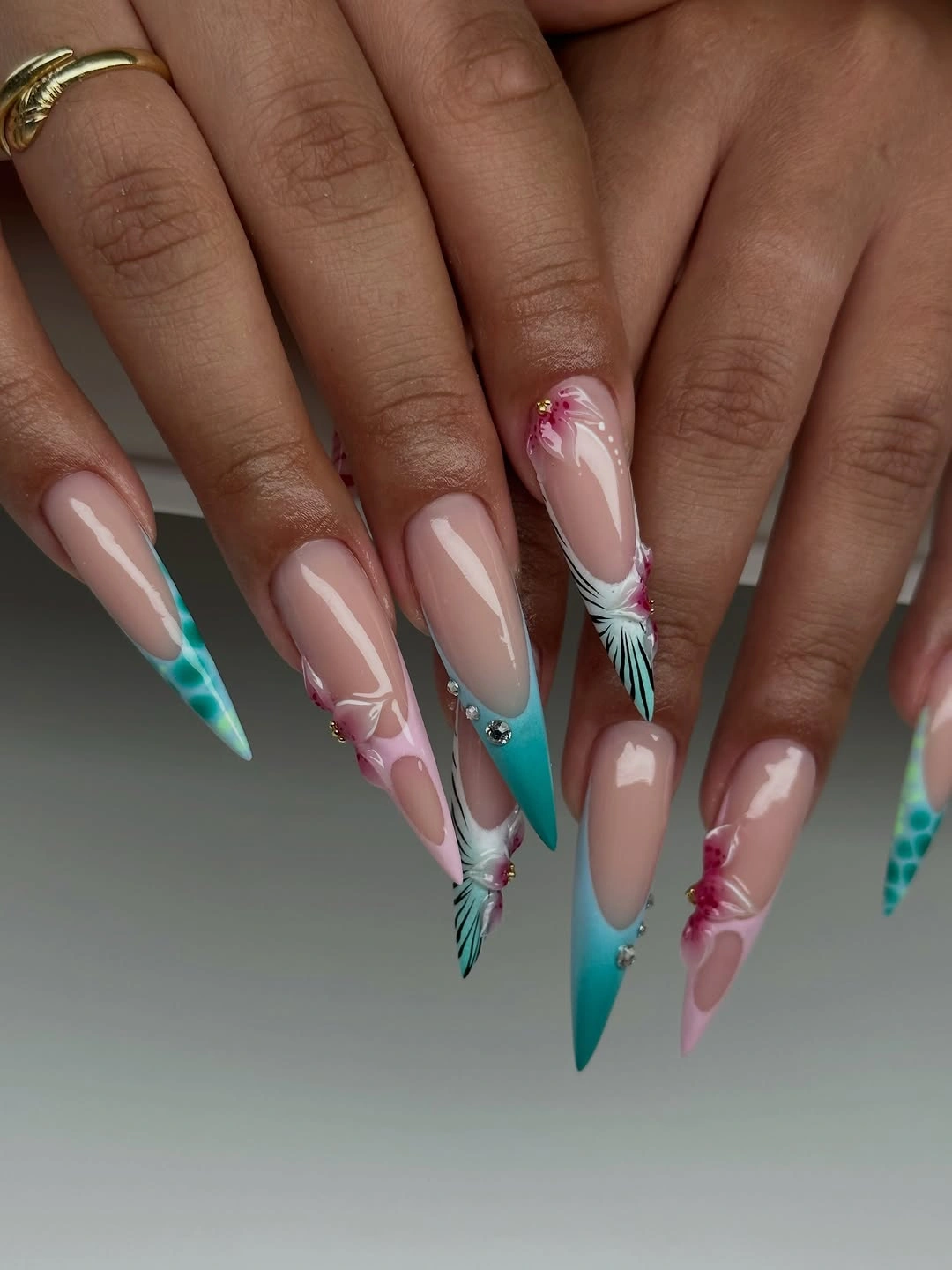
Turquoise works as an edge because it concentrates the strongest color where the nail narrows. White strokes can then move across the pink without competing with a full saturated base, and the small dark marks add definition only where the eye needs it. For a shorter version, keep turquoise on two tips and simplify the white motif to one curved line; preserving the color placement will do more than preserving every detail.
The long shape still creates a maintenance consideration because the tip is the most visible part of the composition. As the nail grows, the distance between the pale base and the turquoise edge can change the balance, while fine white details may become less distinct. A medium almond or soft oval would lower that directional effect, but keeping the cool edge narrow will retain the design’s clearest contrast.
Neutral Nails With Warm Yellow Swirls
Medium-long nude-pink nails carry yellow curved lines, tiny colorful dots, and rounded decorative marks across a pale base. The neutral ground is doing more than filling space: it gives the cheerful yellow enough room to appear intentional, while the moderate length keeps the playful details from becoming theatrical. The design feels expressive through small gestures rather than through a large dark motif.
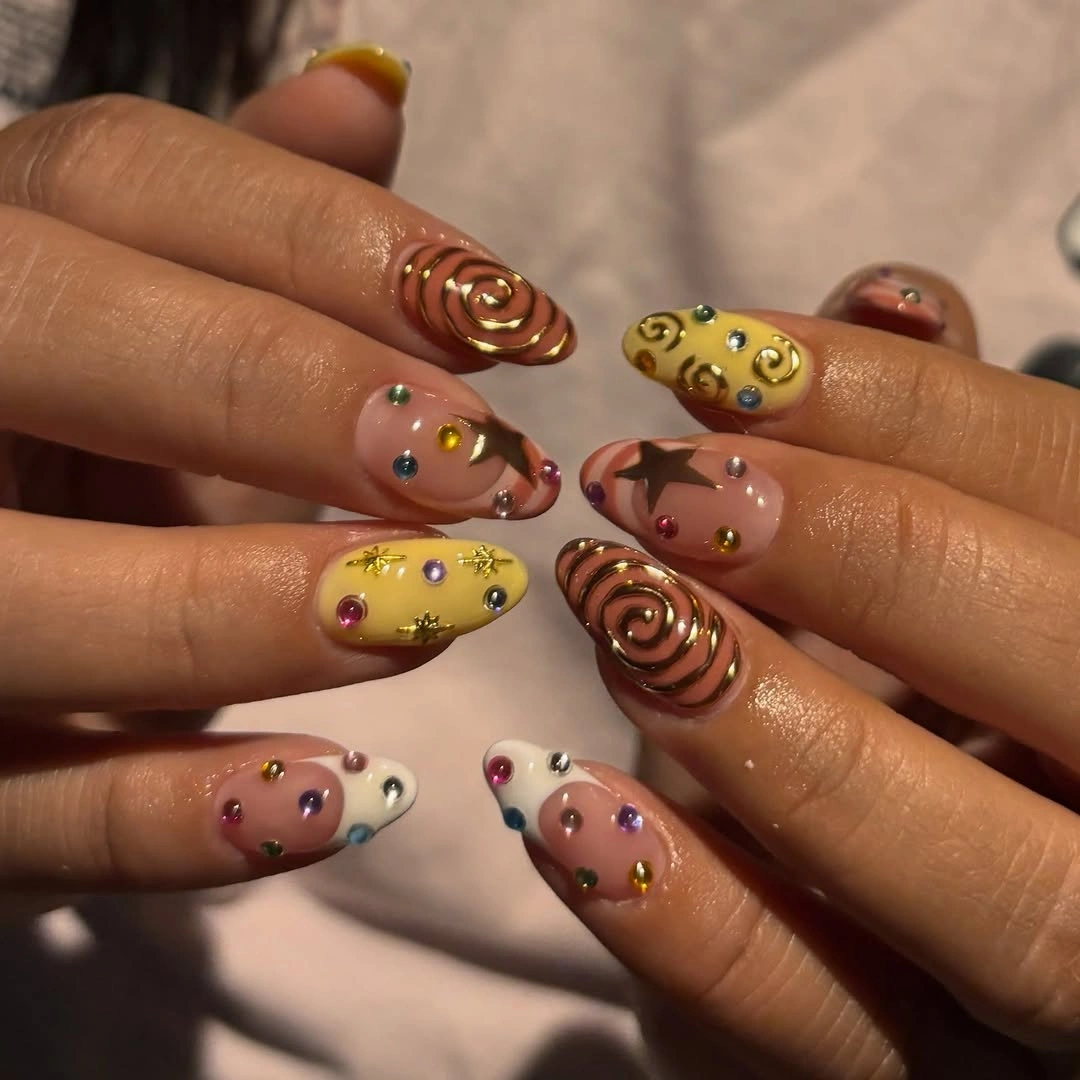
Yellow repeats as the main accent, and that repetition is what ties the individual marks together. The dots and rounded details can change from nail to nail because the warm color keeps returning against the nude background, creating a gentle rhythm rather than a strict pattern. If you want less density, leave the swirls on two nails and use a few yellow dots elsewhere; the reader’s eye will still find the same focal color.
A playful look can become less manageable when every nail has a small illustration-like detail, especially on a shorter surface. Keep the marks separated and avoid adding another major color family unless it already appears in the design, because extra contrast would compete with the yellow. The moderate length is a helpful middle ground, but the simplest route is to reduce the number of accents while keeping the neutral base intact.
Rainbow Tip Bands On Long Stilettos
Very long stiletto nails use narrow bands of red, yellow, green, blue, and pink near the tips, with the bands repeated at slightly different angles. The pattern is controlled rather than freeform, and the shared placement gives the extreme length a strong horizontal rhythm. A dark or nude ground lets the color bands remain separate, so the eye reads each tip as a small graphic panel.
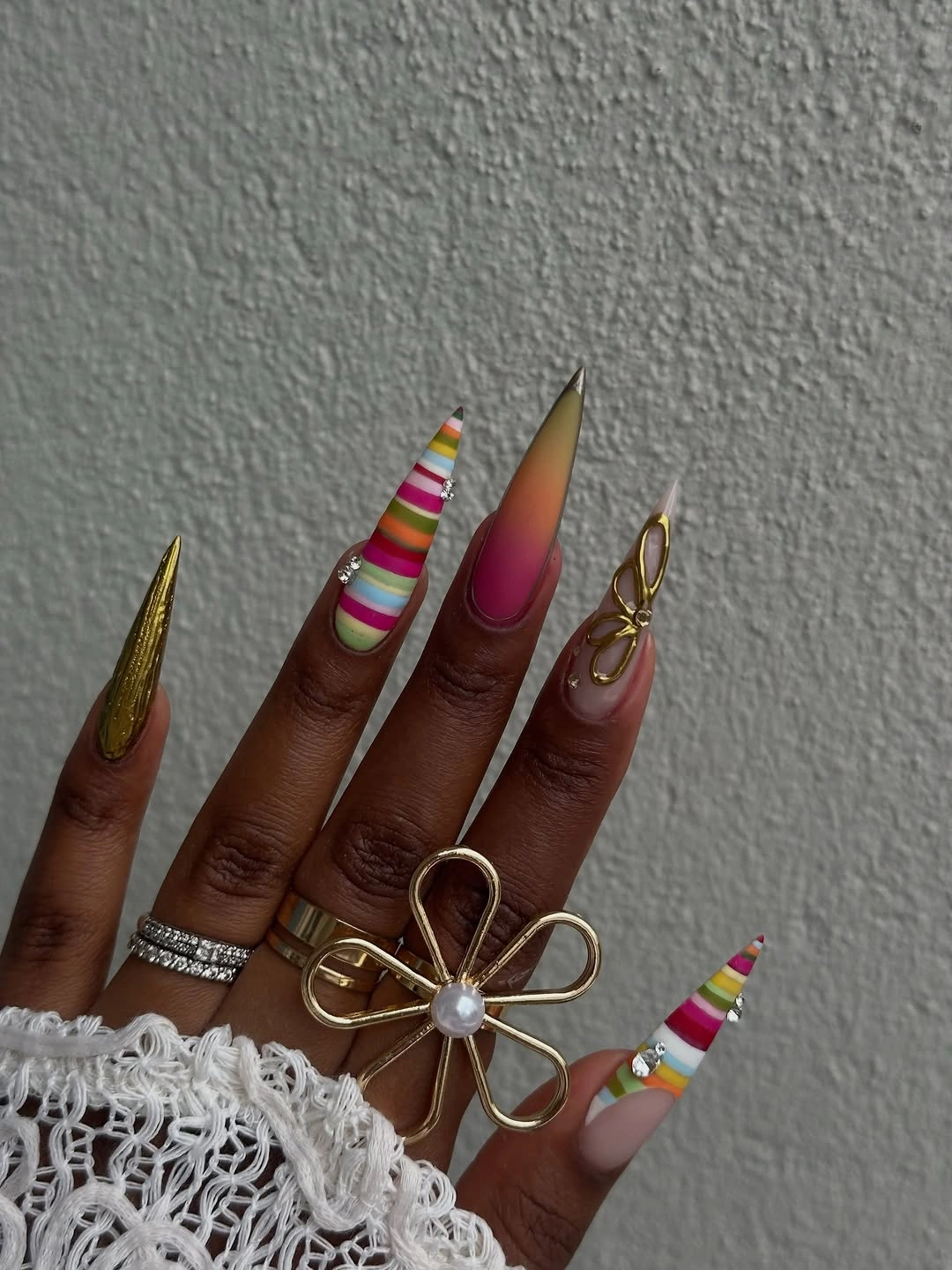
The design works because the palette is broad but the placement is disciplined. Each nail does not need a new motif; the recurring bands provide continuity while the pointed outline adds direction. On a shorter shape, use fewer colors and make the bands wider so they do not collapse into tiny lines, or keep the full palette on two feature nails and choose a plain coordinating color for the rest.
Extreme length gives the stripes room to breathe, but it also makes the manicure more visually assertive than the same bands on a rounded tip. A simpler outfit can help the hands remain the focal point, and a medium almond would reduce the directional force without deleting the color story. If the design must be shortened significantly, protect the repeated band placement first; that is what separates it from random multicolor tips.
Bright Abstract Tips On A Nude Base
Medium almond nails keep a pale nude center while orange, pink, turquoise, and yellow appear in small abstract sections near the tips. The open base matters because it prevents the colors from spreading into one dense block, and the moderate shape gives the bright marks enough width to stay readable. The effect is colorful without requiring full coverage or a single repeating motif.
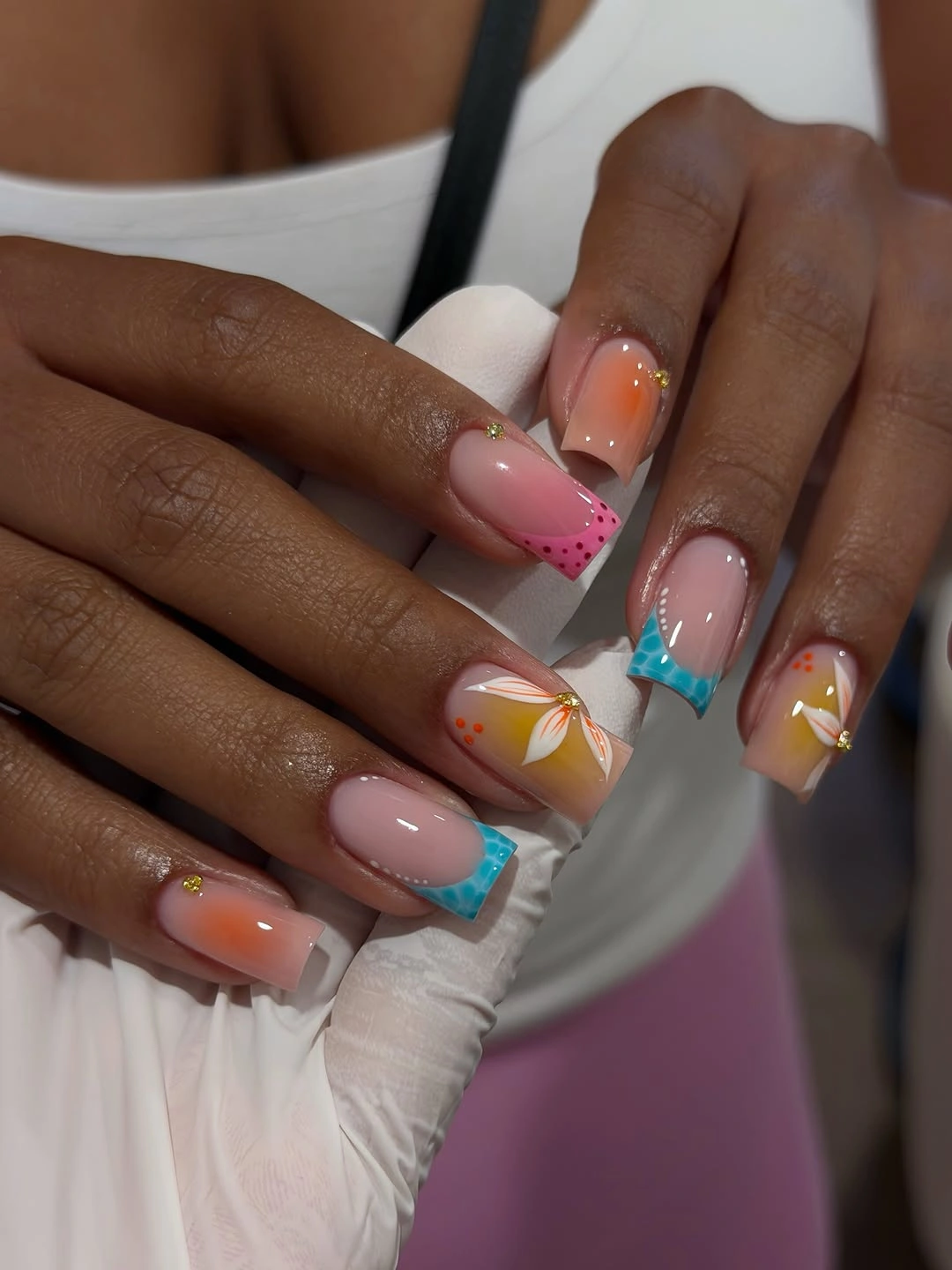
Warm and cool accents are separated by empty space, which makes the palette feel lighter than its number of colors suggests. Orange and pink bring warmth, turquoise interrupts that warmth, and yellow supplies a smaller highlight rather than a new focal field. To adapt the idea, choose two warm accents and one cool accent, then repeat them only at the edge; preserving the open center will keep the design balanced.
This is one of the easier multicolor directions to simplify because the visual weight already sits near the tip. A shorter almond or rounded shape can carry larger, fewer color gestures without losing the concept, while plain nude neighbors will make the accents feel intentional. If the full set looks too playful for daily wear, keep one colorful tip per hand and let the remaining nails stay softly nude.
Red and White Curved Almond Panels
Long almond nails finish the set with rich red, warm orange, and white curved panels that sweep diagonally over the pointed outline. The color is strong, but the movement comes from the direction of each panel rather than from extra decoration. Repeated red-and-white arcs create a visual path from the base toward the tip, giving the manicure a sense of motion without relying on a crowded motif.
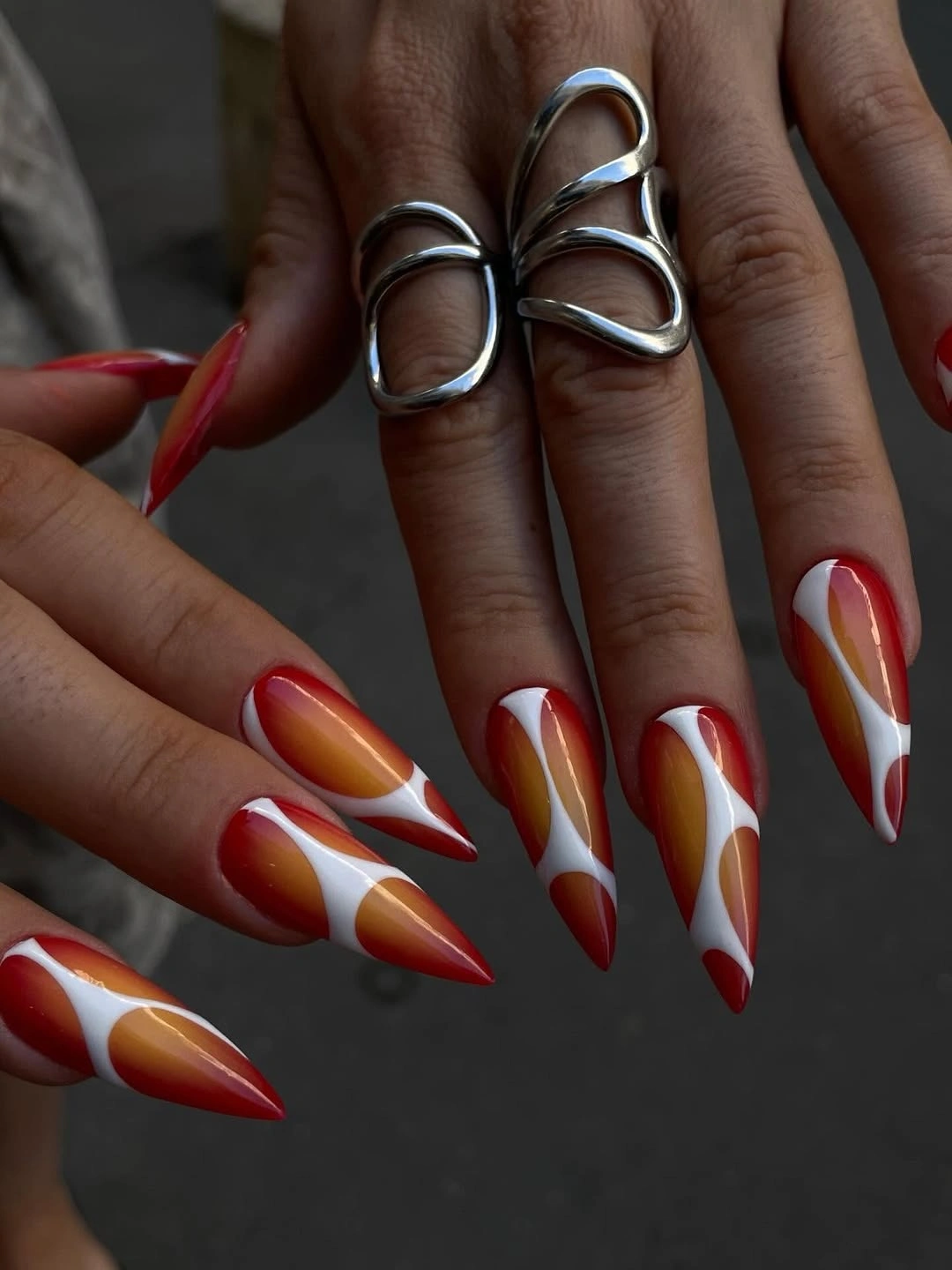
White makes the red and orange easier to separate, while the warm colors keep the pale panels from reading as a purely graphic black-and-white design. The curves follow the length of the nail, so the almond silhouette and the line work reinforce one another instead of pulling in different directions. A shorter almond version should keep the sweeping panels broad and reduce the number of transitions so the pattern remains clear.
The tradeoff is the same structural strength that makes the set memorable: long pointed nails amplify every diagonal line. If that proportion feels too forceful, shorten the tip rather than flattening the curves, because the flowing panels are the defining idea. A plain red or warm nude nail beside one or two patterned accents would also lower the density while keeping the red-and-white contrast visible.