
Some colors only become convincing when they meet the right contrast. A pearl nude can look almost quiet, then catch against a deep skin tone; a hot orange can feel grounded by a rounded edge; a tiny cream dot can turn a saturated hand into a pattern instead of a block. The interesting part is not declaring a shade flattering in the abstract, but noticing what the finish and shape let it do.
Fall is a good excuse to play with that balance because the palette can move between muted and electric without losing cohesion. I prefer a manicure that knows where its eye should land – perhaps on one floral nail, a warm tip, or a clean glossy surface – and lets the other fingers support that decision. That kind of editing often makes a bold color feel more wearable than adding another layer of decoration.
Pearl Nude Almonds with a Warm Reflective Finish
Medium almond nails begin the collection with a warm nude base and a pearly finish that catches light across the surface. The close-up against black gives the reflective layer more contrast, but the manicure itself stays intentionally quiet because there is no visible motif competing with the shape. The rounded point and soft value make this a useful neutral when you want polish without a busy design.
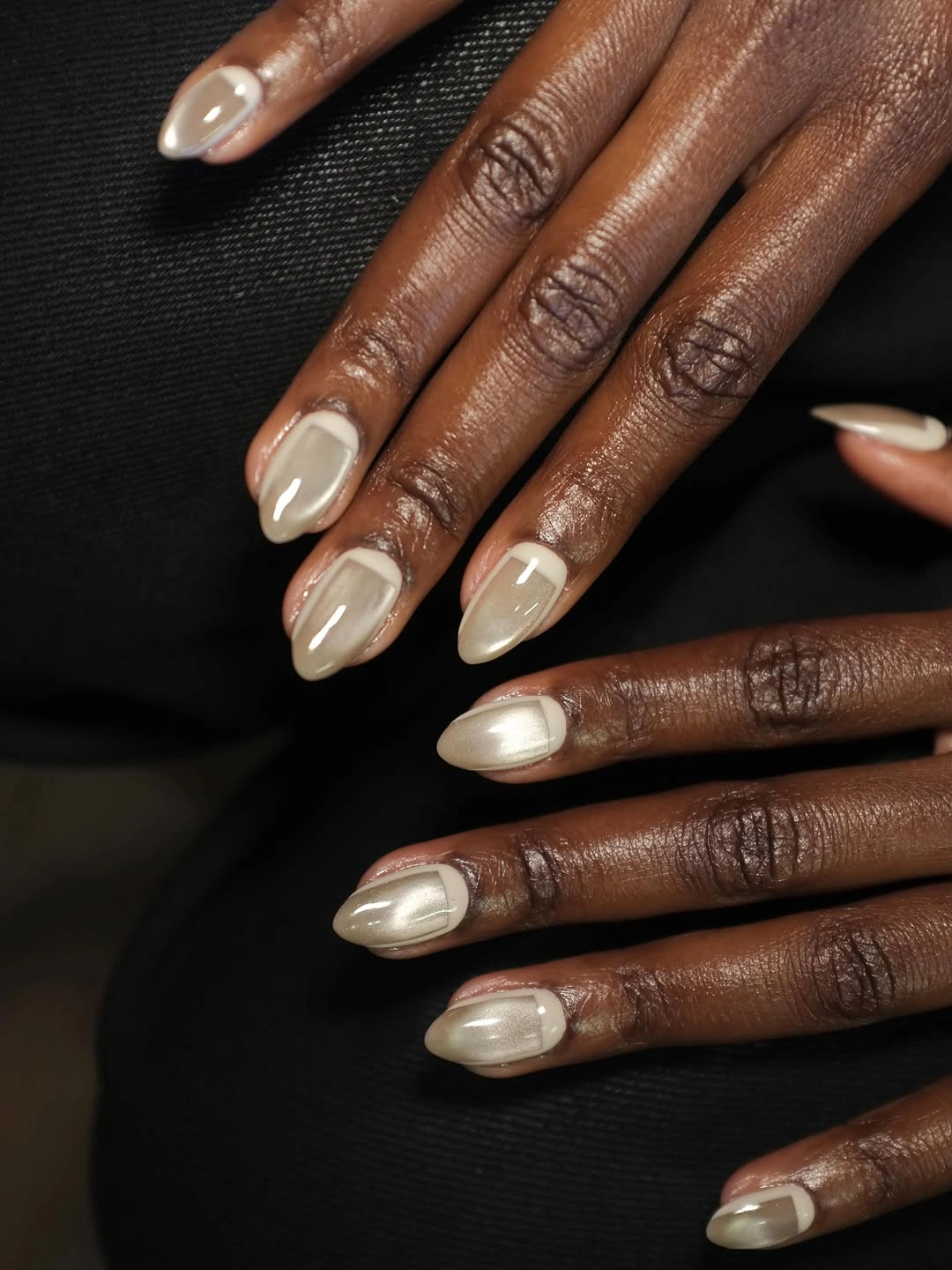
Keep the almond edge moderate and let the light-catching finish cover the nail evenly rather than concentrating it at one tip. That placement allows the surface to glow as the hand moves, while the nude base keeps the color relationship close to the skin instead of turning the manicure into a hard block. A shorter oval can carry the same idea if you preserve the pearl effect and the calm outline.
This is the restrained baseline for the set, so it works well beside stronger clothing or jewelry and gives the eye a place to rest before the graphic ideas arrive. The tradeoff is subtlety: if you want obvious nail art, the shimmer may feel too quiet. Its value is that the finish supplies dimension without requiring extra length or a separate accent finger.
Cream Nails with Tiny Black and Gold Checks
Short rounded nails shift the neutral story into a small checkerboard made from creamy color, black blocks, and metallic-looking gold squares. The motif varies from finger to finger, but the limited palette keeps the hand connected instead of turning every nail into a separate experiment. Because the nails are compact, the grid reads as a crisp detail rather than a large graphic panel.
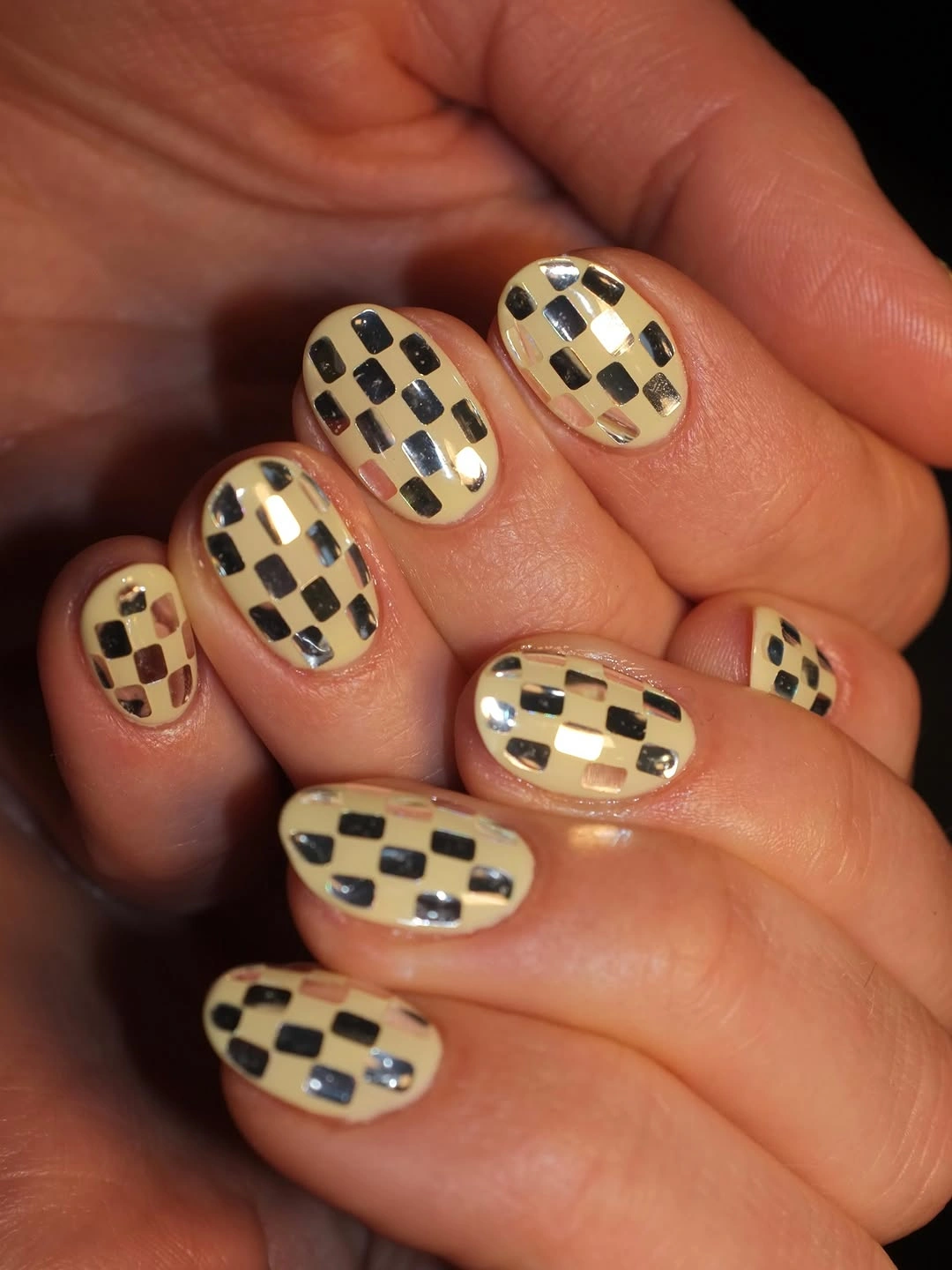
When adapting the design, repeat the checker pattern on only a few fingers and let the remaining nails stay cream or lightly accented. Small squares need enough space to remain distinct, so oversized blocks would make a shorter shape feel crowded and reduce the contrast between the colors. The gold-looking marks can remain sparse; the black-and-cream relationship already gives the manicure its structure.
Compared with the pearl nude, this idea is more playful and more dependent on precise spacing, which means uneven lines will be noticed sooner. It still has an approachable length, so the visual commitment comes from the pattern rather than from a dramatic point or extra-long edge. Choose it when you want a fall palette that speaks through rhythm and repetition instead of a single shade.
Sheer Blush with Tiny Light Accents
Short-to-medium rounded nails carry a translucent blush-pink base with a glossy surface and tiny light accents near selected areas. The color stays close to the hand, but those small marks stop the finish from reading as a flat coat and create a quiet point of interest. The curved edge supports the soft palette, so the result feels airy rather than graphic.
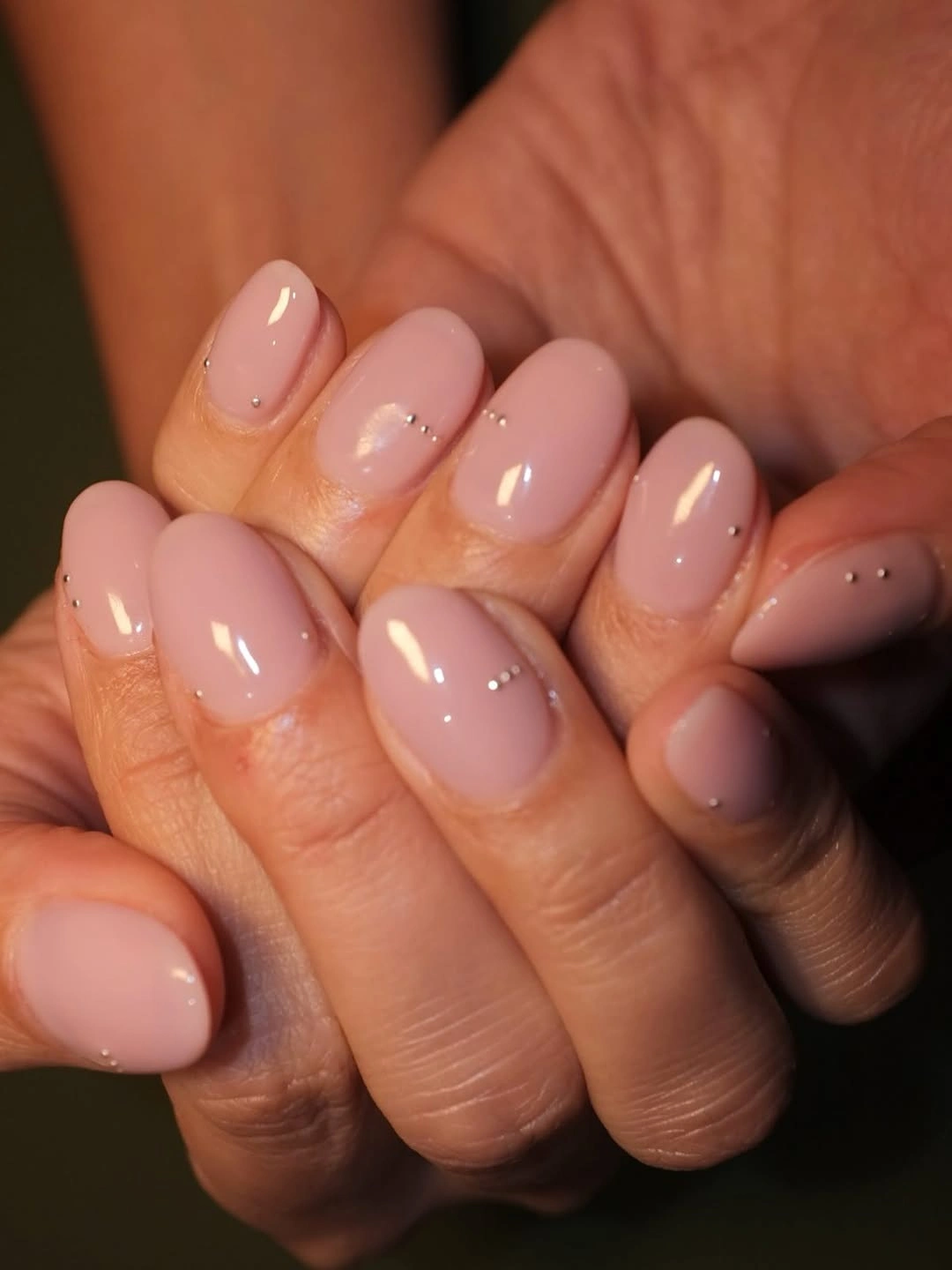
Use a sheer blush layer across the full nail and reserve the small accents for one or two fingers if you want the same balance on a shorter shape. The open base is doing important work: it keeps the hand light and allows the little details to breathe instead of competing with a solid design. If you shift the undertone warmer, keep the accents pale so the contrast remains controlled.
This is easier to pair with different colors than the checkerboard and less dependent on exact illustration, though a translucent base can reveal uneven application more readily. It suits a reader who wants a polished fall option without obvious orange or brown. The manicure keeps its interest through surface and spacing, not through a crowded collection of motifs.
Soft Neutral Almonds Balanced by Jewelry
The manicure here stays simple: long almond nails appear in a pale neutral tone while a large silver ring and textured clothing provide the surrounding contrast. That context makes an important color lesson visible without turning the accessories into the subject. A calm nail surface can look deliberate when the hand already carries a strong reflective or sculptural detail.
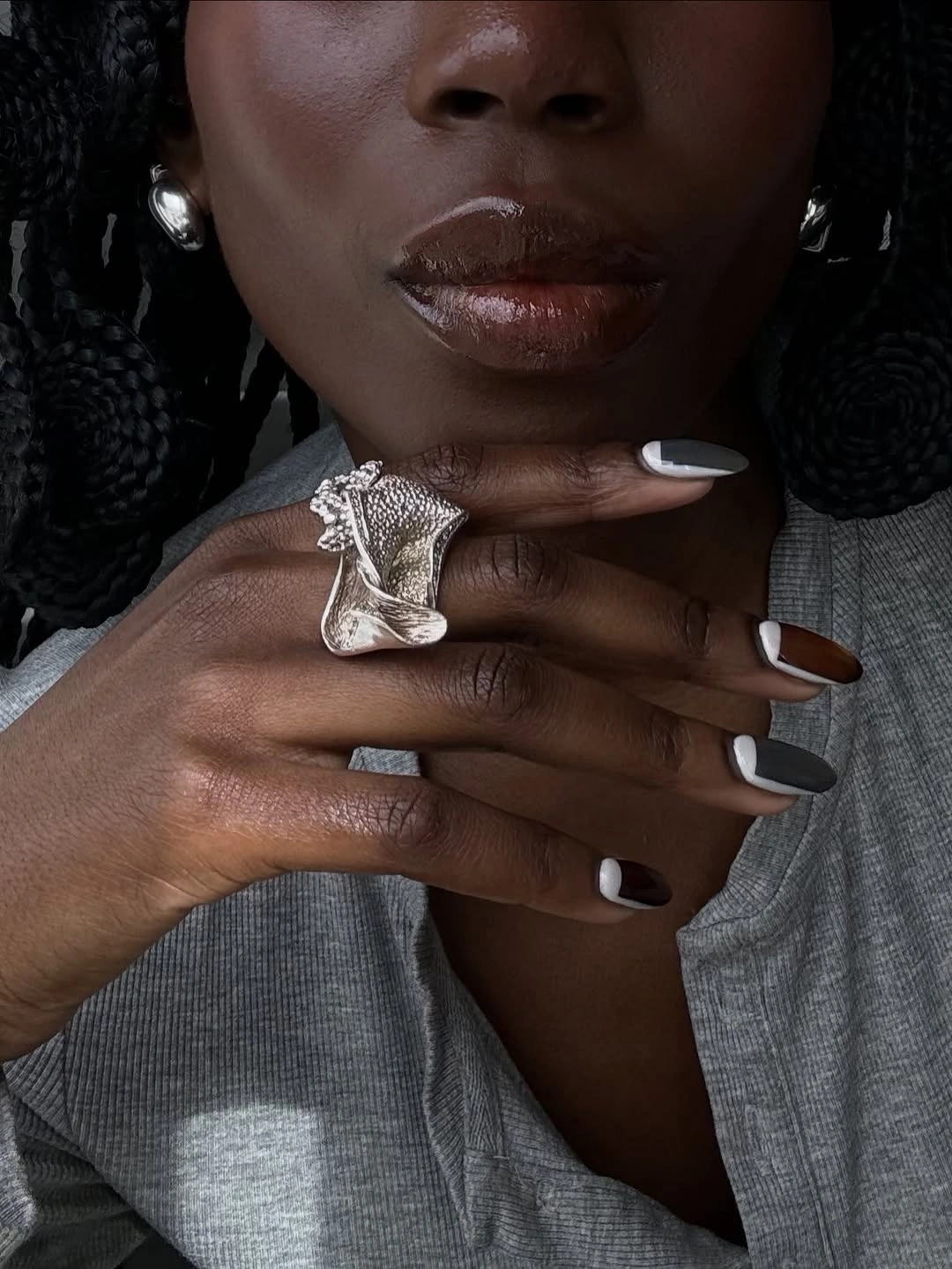
Keep the nail color restrained if you plan to wear a prominent ring, or reduce the jewelry when you want the almond shape to lead. The pale base supplies negative space against the skin, so adding multiple motifs would weaken the quiet balance that makes this combination work. A creamy beige or soft pink can follow the same logic as long as the finish remains even.
Compared with the decorated designs later in the set, this look is not trying to win attention through pattern or saturation. Its strength is coordination: the nails support the hand instead of competing with it, which can be useful for occasions where accessories matter. The honest limitation is that a simple pale surface leaves chips and uneven borders easy to spot.
Short Multicolor Nails with Dotted Rhythm
Short rounded nails mix red, white, yellow, blue, and warm neutral bases, then repeat small contrasting dots in clusters across the hand. Each finger has a slightly different color arrangement, yet the shared dot scale creates a rhythm that keeps the palette from scattering. The compact length makes the experiment cheerful without relying on a long pointed silhouette.
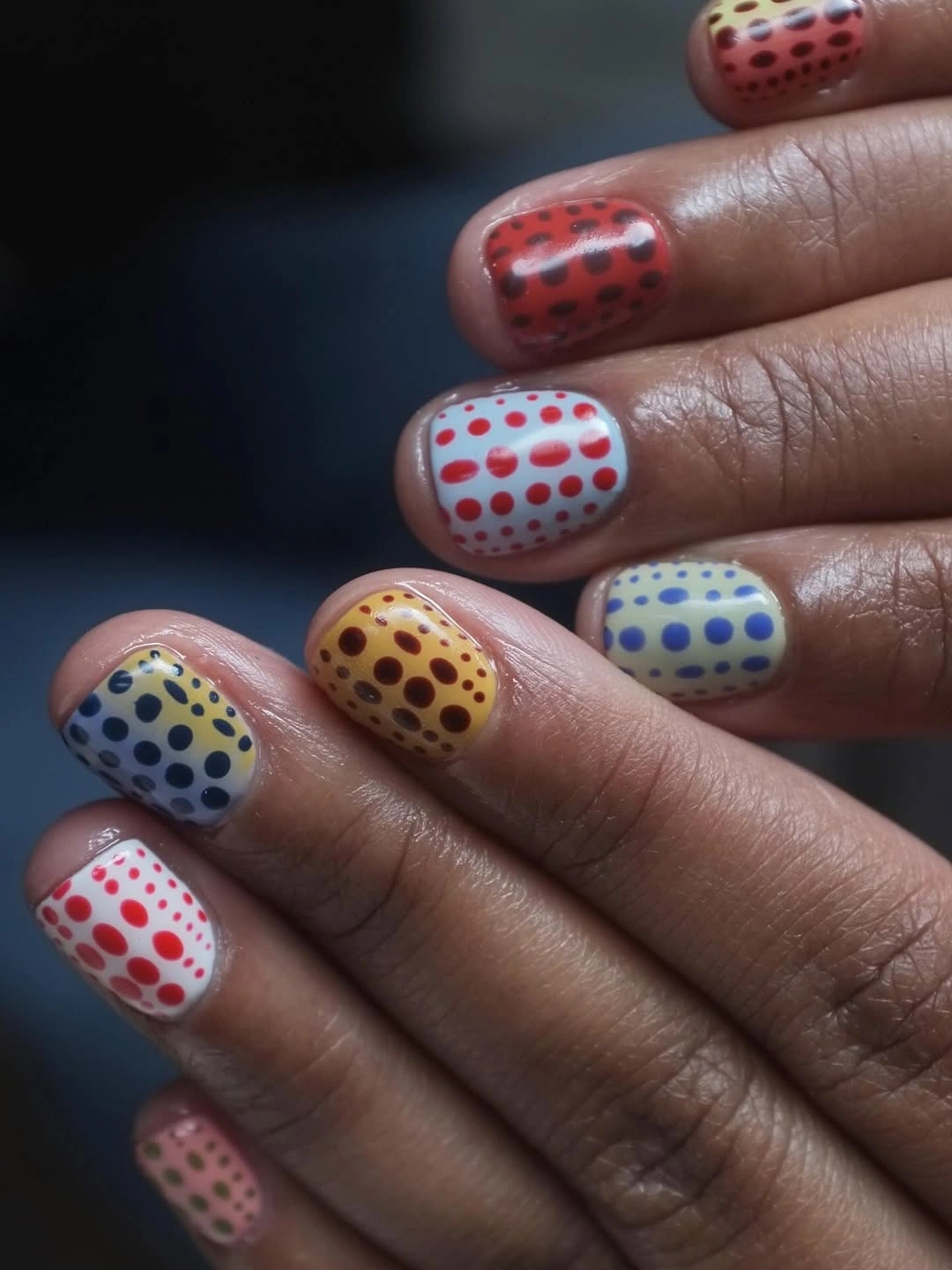
Keep the dots small and repeat two or three base colors if your nails are shorter than the visible shape. Large spots would take over the surface, while a limited palette would preserve the playful contrast without making every finger demand equal attention. The idea can also be softened by using cream instead of white or a muted orange instead of the brightest red.
This manicure is more expressive than the neutral options, but it remains fairly approachable because the shape is not extreme and the motif is easy to understand. The tradeoff is visual busyness: the more colors you add, the more important the repeated dot size becomes. It is a good choice when fall means trying a lively palette rather than settling into one dark shade.
Warm Iridescent Color Concentrated at the Tips
Long slender nails use a translucent neutral base with orange, copper, and pink color concentrated near the tips. The warm effect shifts subtly across the surface, but the open base keeps the manicure from becoming a full block of saturated color. The narrow shape emphasizes the vertical gradient and lets the tip act as the main focal zone.
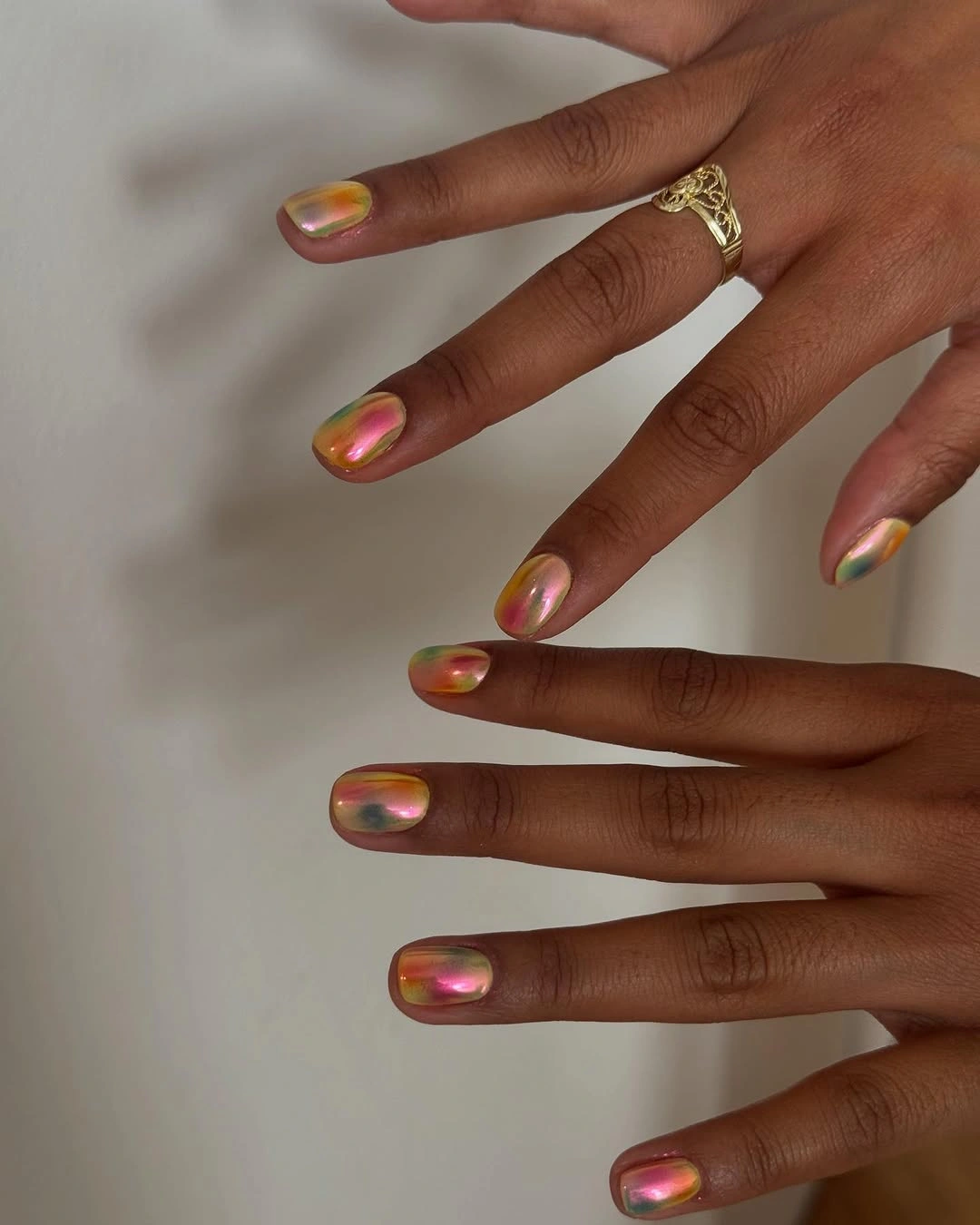
Place the reflective color close to the free edge and leave enough clear-looking space below it to preserve the floating effect. That separation matters more than adding additional art, because the design is built around the transition between quiet base and warm tip. If you need a shorter version, use the same color placement on an almond shape and reduce the band rather than covering the nail.
This is more elongated and polished than the dotted set, with a finish that feels seasonal without naming one exact shade. The practical tradeoff is precision: uneven edges or a rough tip will be easy to see when the light catches them. Choose it when you want warmth expressed through reflection and placement instead of an all-over orange.
Tortoiseshell, Nude, and Raised Floral Accents
Long tapered nails combine translucent nude space, brown tortoiseshell, deep burgundy, white flower petals, and metallic-looking details across separate fingers. The manicure feels layered because the quiet nails give the patterned and floral accents room to register. No single motif covers the whole hand, so contrast in scale becomes the organizing principle.
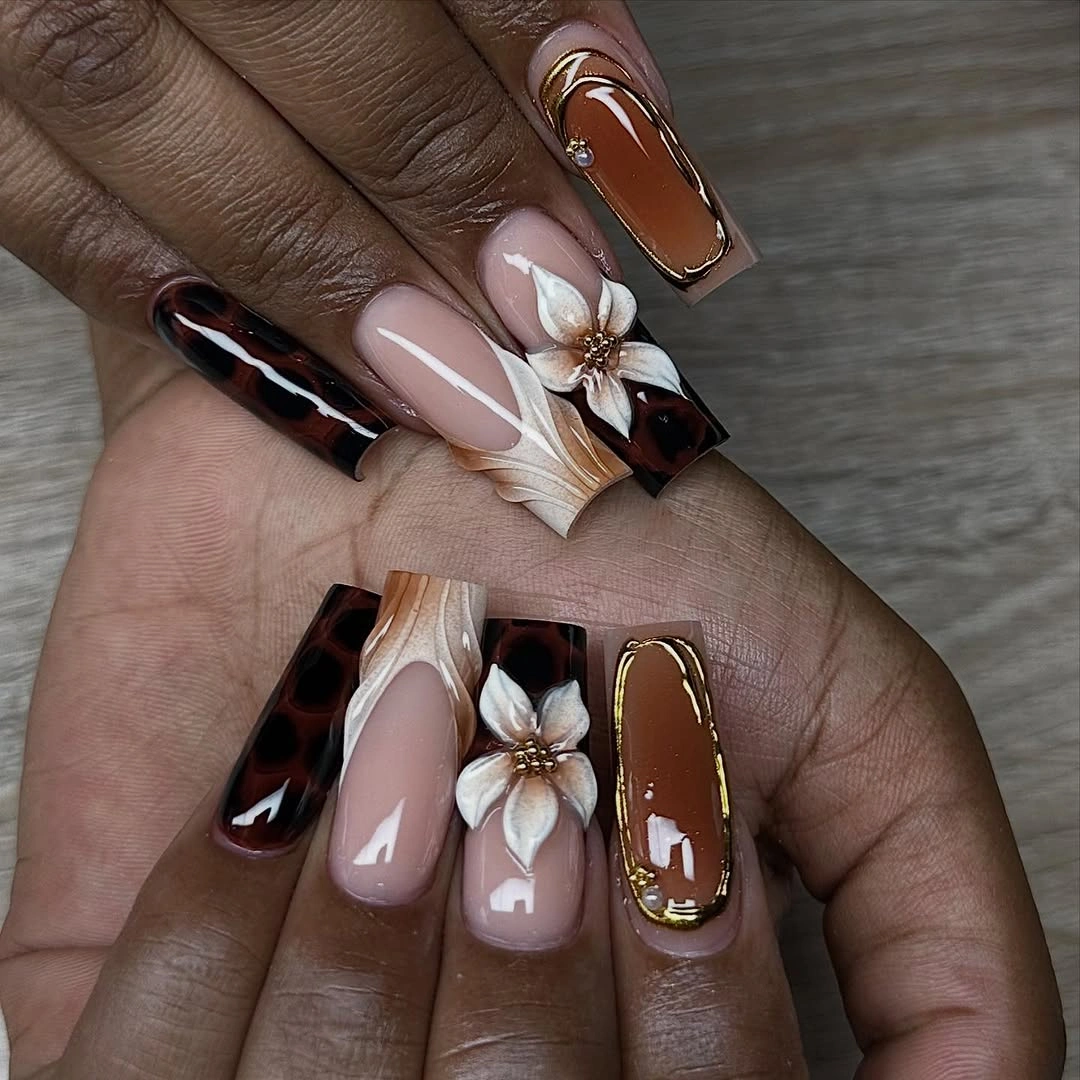
For a shorter adaptation, keep one tortoiseshell finger and one floral accent while using a simple nude or burgundy on the rest. That preserves the relationship between patterned depth and open space without asking every nail to carry the same amount of detail. The darker accents can be shifted toward brown or olive if you want the fall palette to feel less wine-toned.
This is richer than the pearly looks and more dimensional than flat line work, but the extra accents also create a realistic upkeep cost. Raised-looking petals and small metallic details can catch attention when they shift, especially on a long pointed edge. The design suits someone who wants a curated mix of textures rather than one repeated pattern across all fingers.
Lilac Almonds with Yellow Tips and Gold
Long almond nails use a muted lilac or pale mauve base with slim yellow tips and small gold star-like details on selected fingers. The cool base gives the yellow edge clear contrast, while the repeated almond shape keeps the mixed palette from feeling scattered. It is a cool-toned fall idea that does not depend on brown, red, or orange to feel considered.
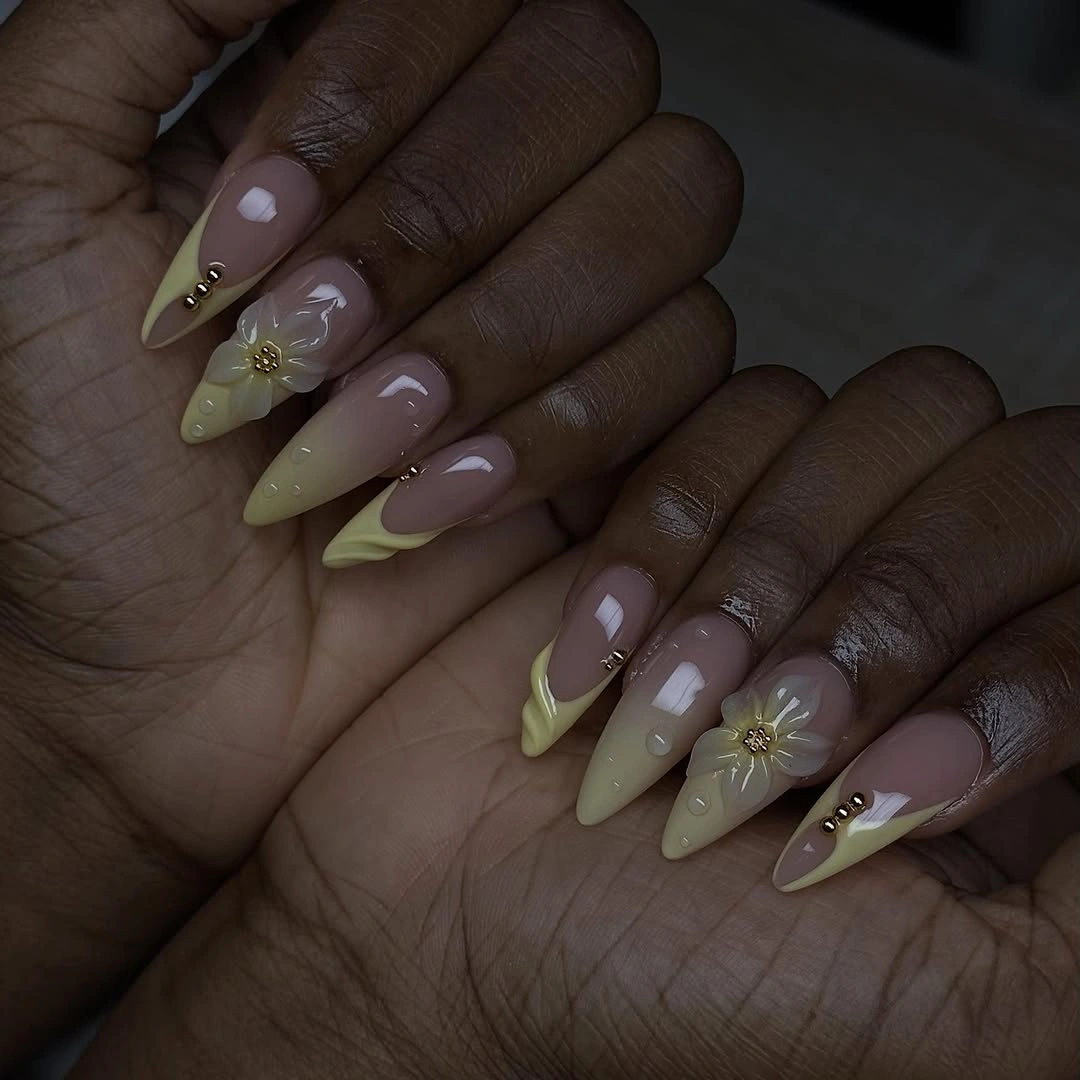
Use the colored tip on two or three nails and place the tiny metallic details near a base or side so the eye has a clear path across the hand. On a shorter shape, a single yellow edge color will usually read more cleanly than several small accents. If you prefer a warmer result, replace lilac with dusty rose but keep the tip narrow so the balance between base and edge stays intact.
This option is cooler and lighter than the copper designs, so it changes the seasonal mood through contrast rather than through a dark value. The long almond point still carries a practical length commitment, and small gold details need care to remain visually tidy. Pick it when you want a soft color relationship with a clear, slightly unexpected edge.
Pink Stiletto Nails Framed by Neon Outlines
Long stiletto nails place glossy pink in the center and frame the pointed edges with sharp black, blue, green, and yellow outline bands. The colors are bright, but the outline follows the nail shape like a border, which keeps the contrast organized. The result is graphic first and seasonal second, using the shape itself to create the visual direction.
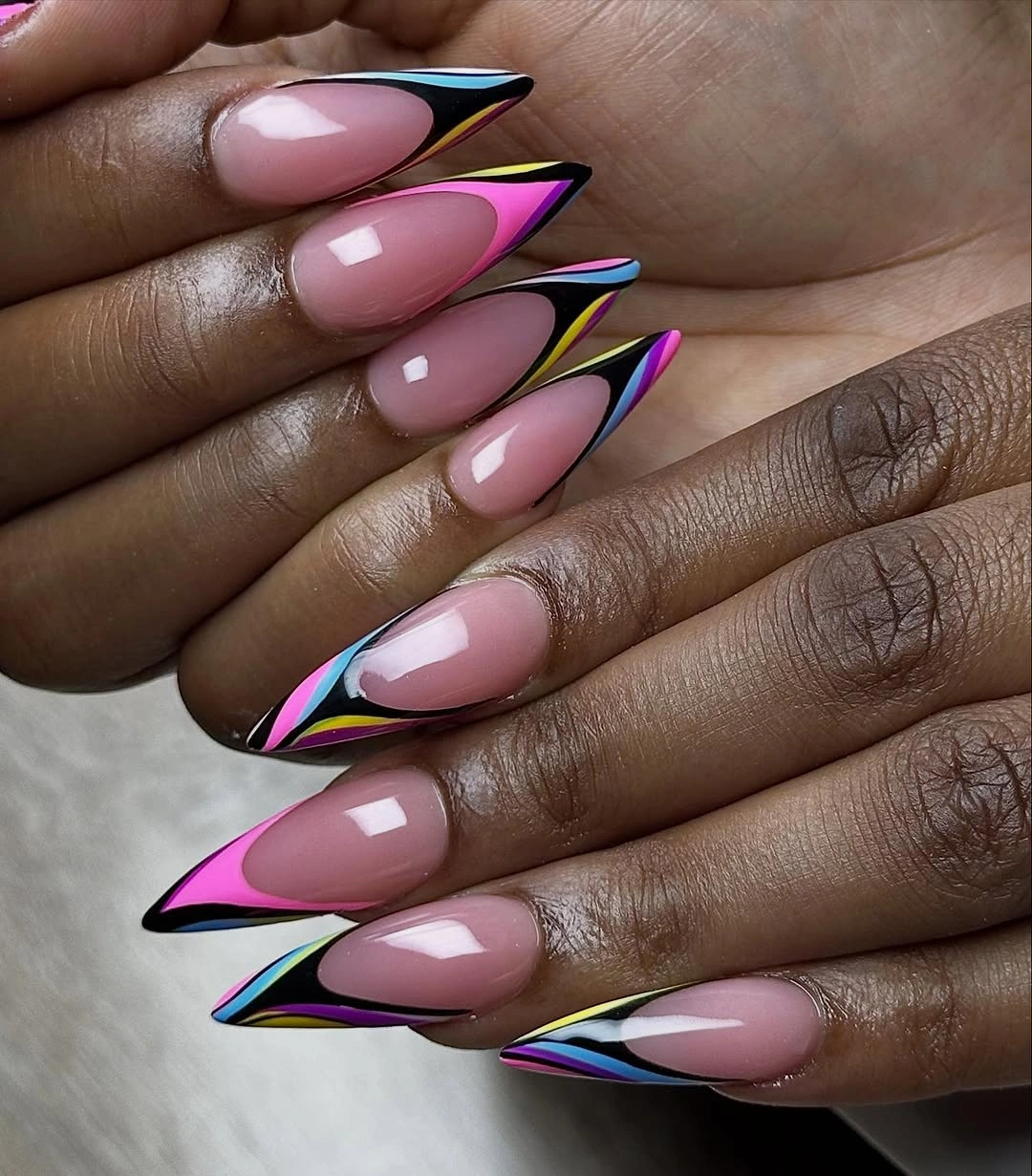
For a more wearable version, keep the pink base and choose one outline color, such as black or a single saturated blue. Multiple borders need both length and carefully spaced edges to remain readable, so reducing the palette is more effective than shrinking every line until it becomes crowded. A shorter almond can preserve the framed-tip idea while making the silhouette less pointed.
This is one of the boldest designs in the collection and asks for more commitment than the lilac almond set. Its payoff is unmistakable definition at the edge, while the tradeoff is that growth, chips, or uneven borders change the graphic effect quickly. Wear it when the manicure should be the strongest color statement rather than a quiet supporting detail.
Olive Floral Almonds with a Soft Pink Base
Long pointed nails pair a soft pink base with olive green panels, creamy white flowers, and metallic-looking accents on selected fingers. The muted green gives the light floral details a grounded fall direction, while the pink keeps the hand from becoming too dark or heavy. The palette is decorative, but its colors remain connected through the repeated olive and blush relationship.
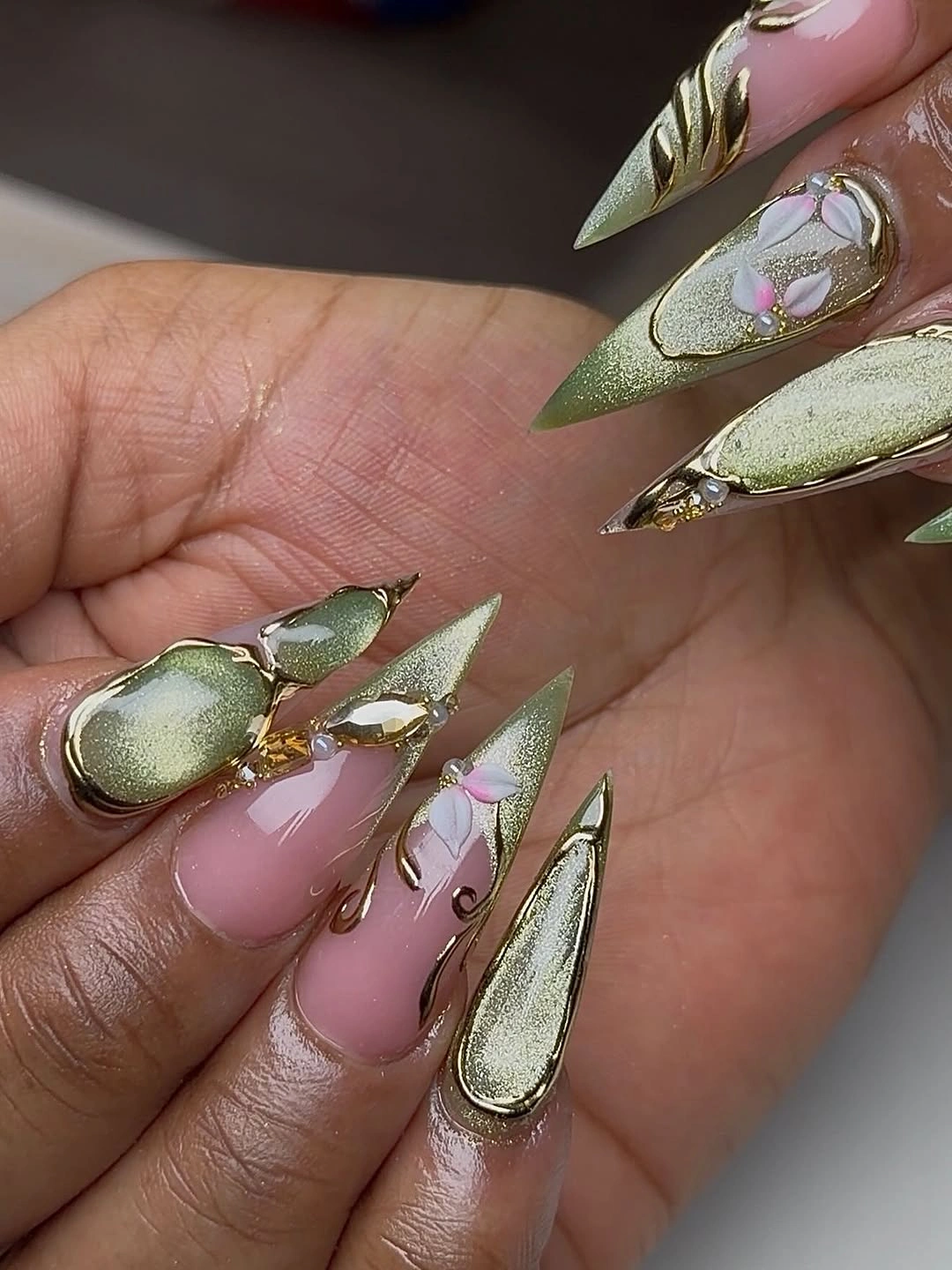
Keep the flowers on two accent nails and use a single olive edge or panel on the rest if you want to shorten the idea. That hierarchy lets the botanicals remain the focal point instead of asking every finger to carry flowers, foil, and color changes at once. A cream base can replace the pink when you want more contrast against the green while keeping the same structure.
The design is more controlled than the neon outline because its accents are concentrated and its palette is quieter. It still has a long pointed edge and small light motifs, so everyday upkeep will be more visible than with a simple neutral. Choose it for an earthy floral look where muted green does the seasonal work and pink keeps the contrast gentle.
Pink Stiletto Nails with Oversized Floral Art
Very long tapered nails use a blush-pink base with large bright pink flowers, glitter, and raised-looking decorations spread across several fingers. The flowers repeat at different sizes, creating a lively rhythm while the shared pink base keeps the hand connected. This is a maximal floral direction, so the scale of the accents is as important as the color itself.
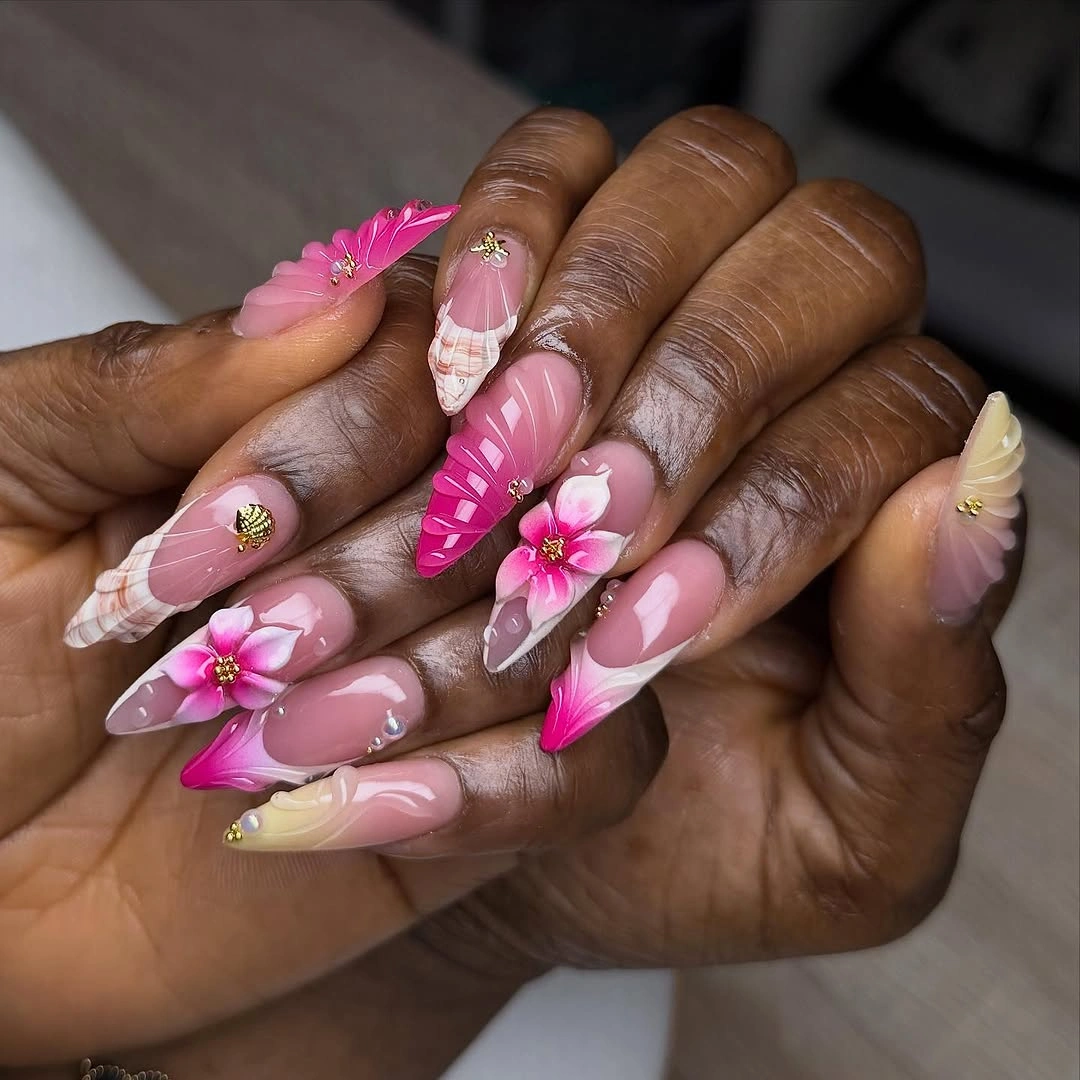
For a shorter version, keep one oversized flower on a single accent nail and let the other fingers stay glossy pink. That preserves the mood without filling every small surface, and it gives the eye a clear focal point instead of a continuous field of petals. If you replace the bright pink with coral or burgundy, keep the base lighter so the flower remains distinct.
Compared with the olive floral set, this manicure is louder and more dependent on length and dimensional detail. The tradeoff is practical: raised-looking elements can be the first feature to shift, and very long points change how the hands move through ordinary tasks. The reward is a deliberately expressive design that does not pretend to be minimal.
Orange-Red Stiletto Nails with Jeweled Details
Very long stiletto nails glow in orange and red, with pointed silhouettes, metallic-looking ornaments, and small decorative elements placed across the surface. The warm colors already create a strong vertical line, so the extra details work as flashes rather than as the main structure. That gives the hand heat and movement without making every nail identical.
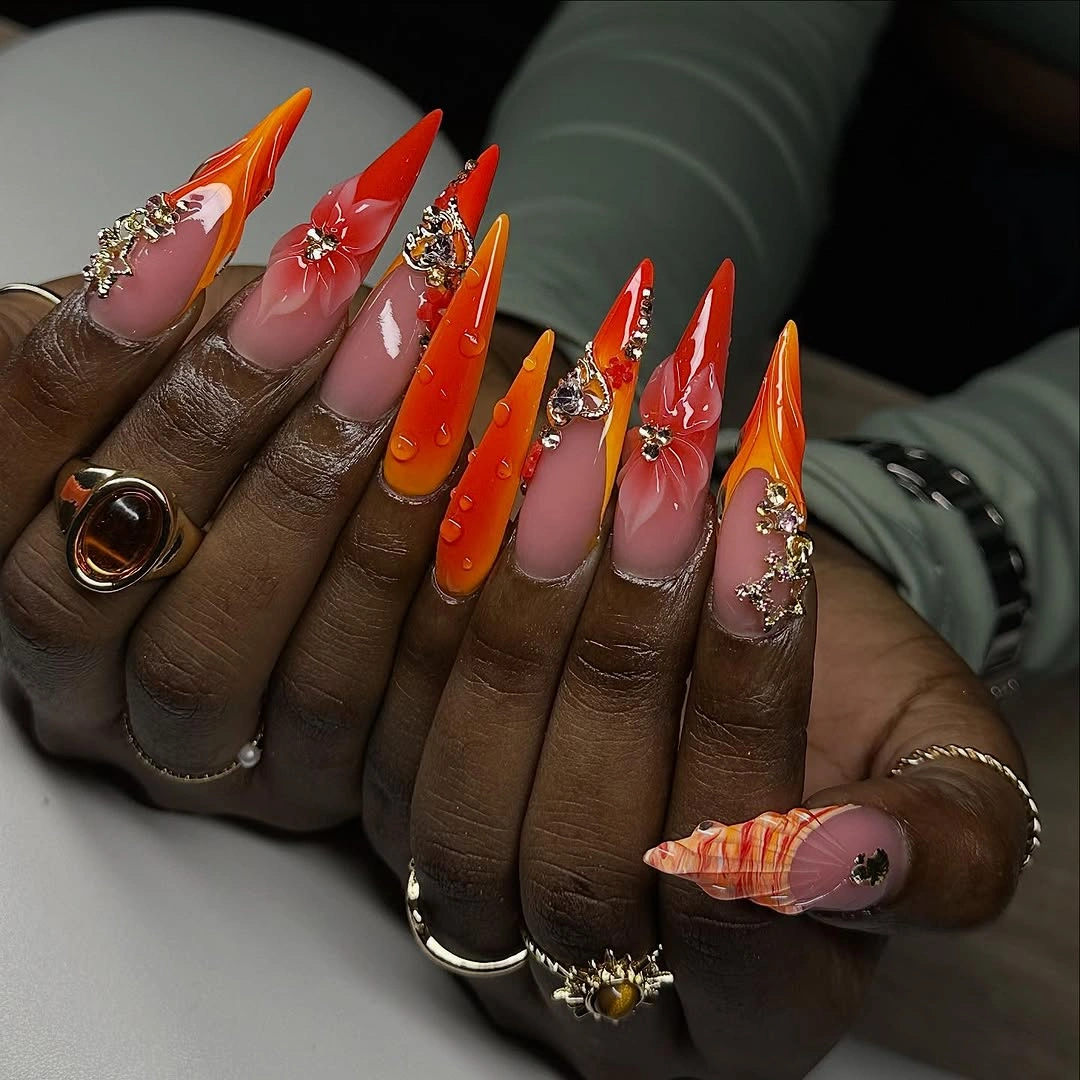
Keep the orange-red family and move the largest decoration to one or two nails if you want a shorter or calmer adaptation. The length is part of the original drama, but the color relationship can survive on a medium almond or tapered square when the tips remain clean. Avoid adding several unrelated accents; the warm palette is strongest when it stays concentrated.
This design has more visual heat than the pink floral set and a sharper upkeep tradeoff because both the pointed edge and the decorative details ask for attention. It suits a reader who wants the manicure to be seen from across a room, not someone looking for a quiet neutral. The coherent decision is to let orange and red lead while the metallic notes remain secondary.
Blue Square Nails with Pink and White Flowers
Long square nails alternate saturated periwinkle blue, dusty pink, white flowers, and small reflective accents across the hand. The square shape gives the bright blue a stable frame, while the lighter floral details break up the block color without removing its cool focus. The palette feels structured because the same blue and pink relationship returns from finger to finger.
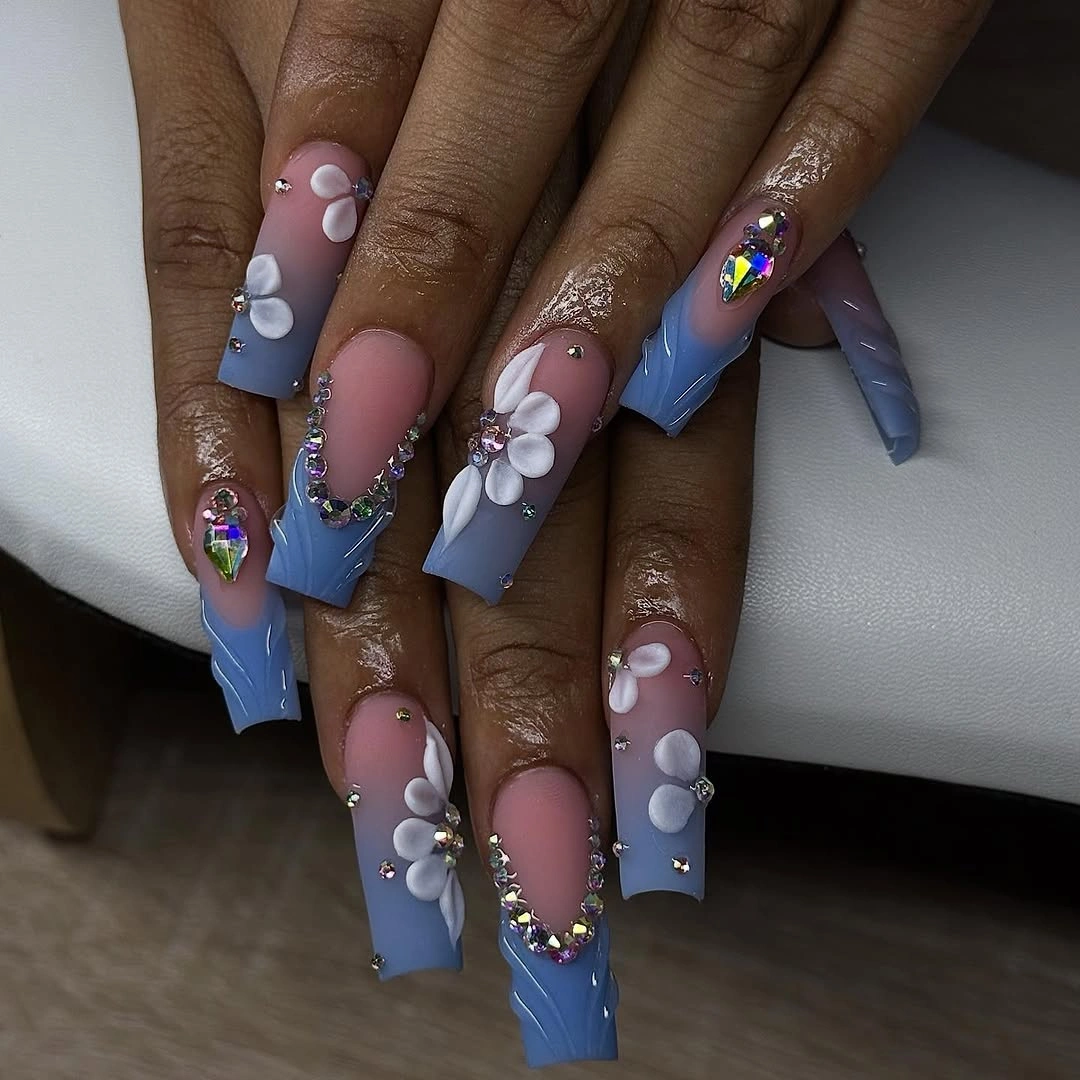
Keep the saturated blue on the main fingers and reserve flowers for two accents so the color blocks remain easy to see. A shorter square can carry the same idea if the flower clusters are simplified and the reflective details are kept small. If you want less contrast, shift the blue toward a softer periwinkle while maintaining the white-to-pink accent relationship.
Compared with the pointed orange set, this manicure is more architectural and graphic, even though it still includes flowers and shine. The squared length asks for care around the corners, but the stable outline makes the design feel less sharp than a stiletto. It works when you want a cool statement that is organized by shape as much as by color.
Nude Stiletto Nails with Zebra-Style Tips
Long stiletto nails start with a nude base and finish with sharp black-and-white striped tips that angle toward the point. The open base supplies negative space, so the high-contrast lines can read clearly instead of covering the whole nail. Shape and pattern point in the same direction, giving the design a clean graphic finish despite the strong contrast.
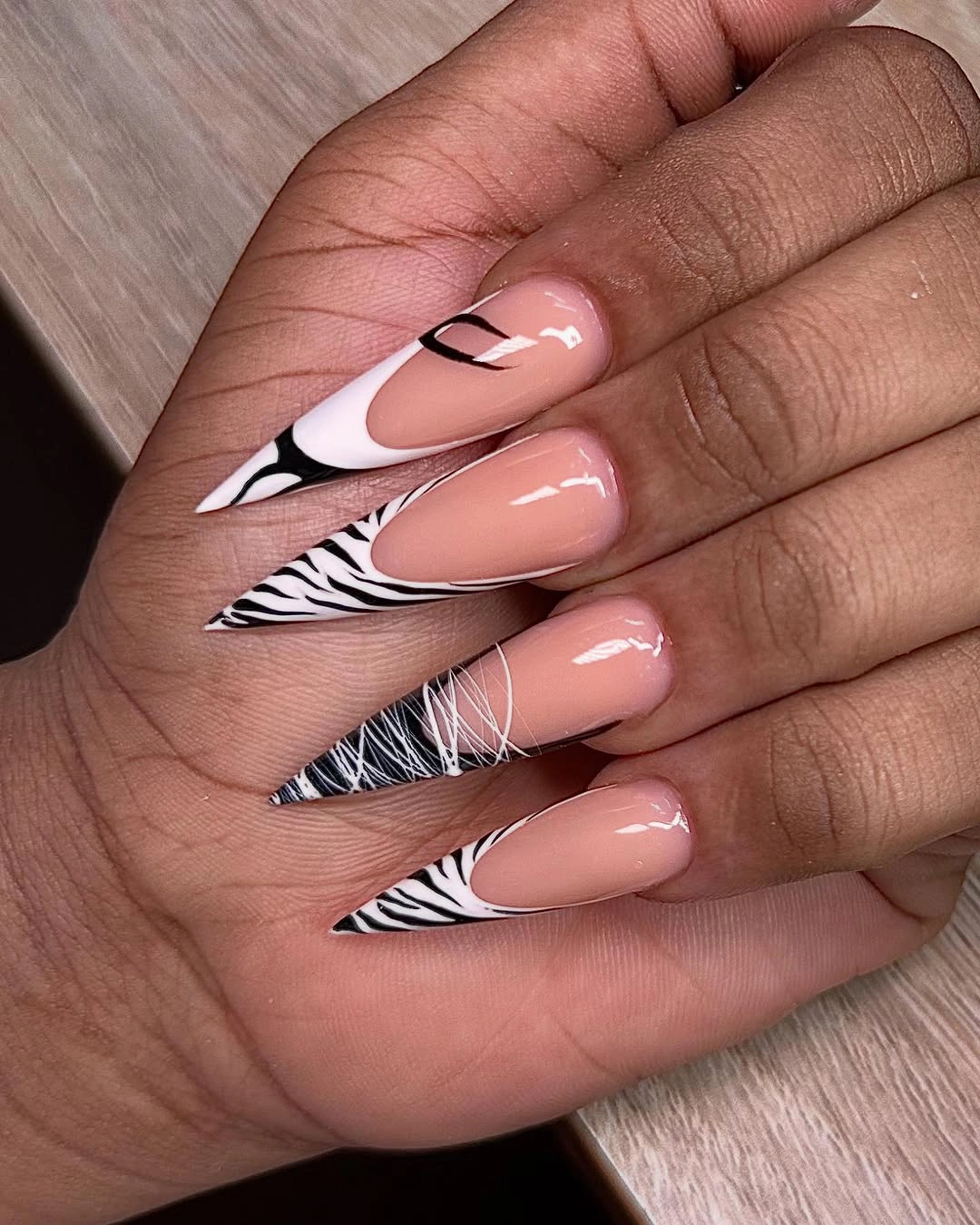
Keep the stripes at the tip and shorten the point slightly if you want the look to feel more practical. Extending the lines down the entire nail would remove the nude-to-graphic transition, while using fewer stripes may help a shorter surface stay legible. A cream base can soften the contrast without changing the idea of a framed edge.
This is more restrained than full-coverage art but still has immediate visual impact, making it a useful choice for someone who wants pattern with breathing room. The thin black lines are also the maintenance checkpoint: smudging or uneven spacing will show quickly. The design works best when the nude area remains generous and the stripes stay disciplined.
Pink and White Squares with Floral Clusters
Long square nails combine a translucent pink base, white French-like tips, small gold accents, and clustered flowers with jewel-like centers. The white edges keep the base light, while the decorations gather attention on selected fingers instead of making every nail equally dense. The mix feels occasion-ready because the palette stays pale even when the details become ornate.
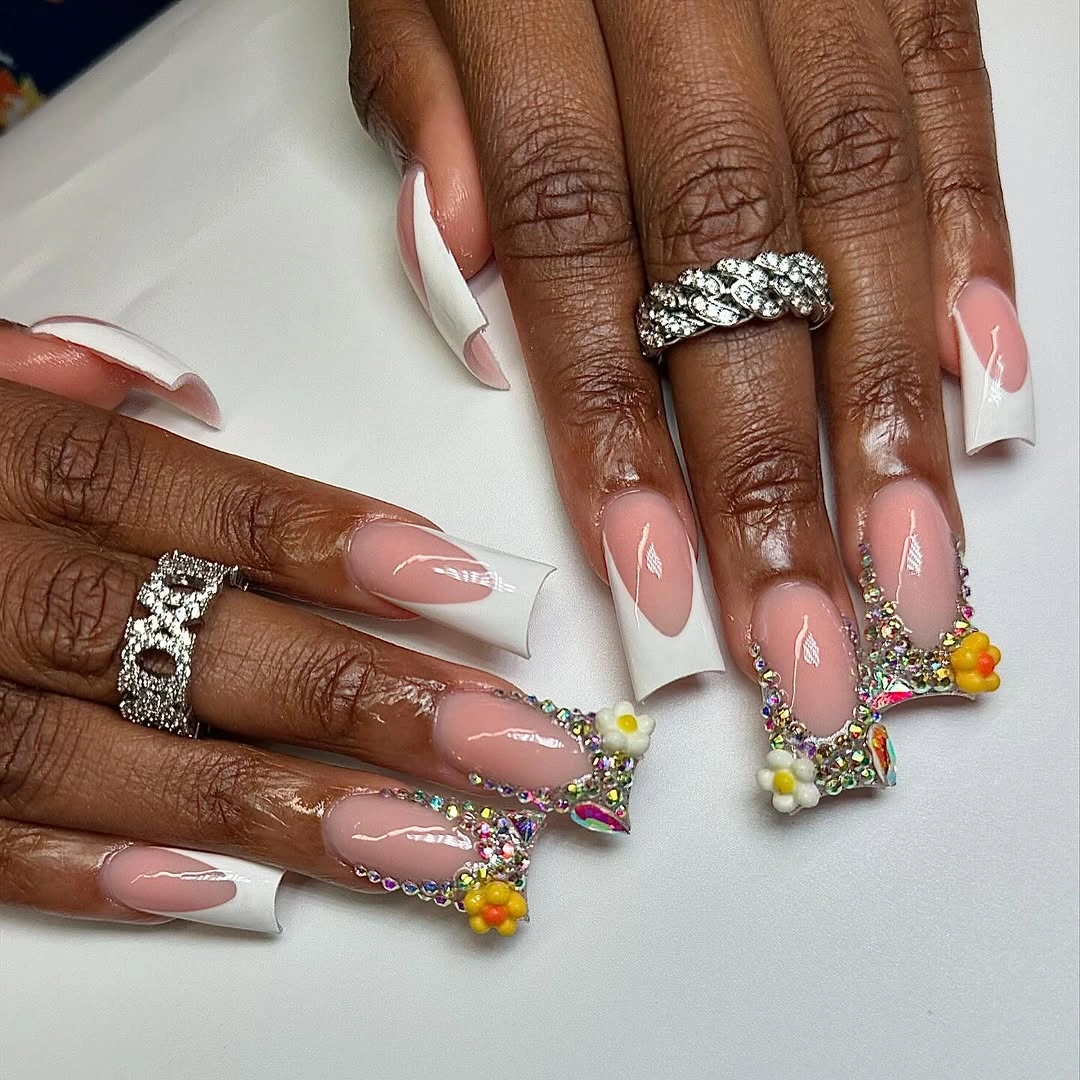
Use the white edge across the hand and move the flower cluster to one accent nail if you need a shorter or more manageable version. That keeps the pink-and-white structure intact while giving the eye a clear focal area. Gold can remain a tiny note near the flower rather than spreading across the rest of the manicure, because the pale contrast already does enough work.
Compared with the checkerboard design, this manicure is softer and more decorative, and compared with the maximal pink flowers it is more controlled. The long square corners and small accents still carry a visible upkeep cost, especially when the edge begins to grow out. Choose it when a light base should feel detailed without becoming brightly multicolored.
Milky Lavender Gradient on Long Nails
Long tapered nails shift from milky pink near the base into pale lavender or blue at the tips, with a glossy finish and almost no surface art. The elongated shape stays visible because the color change is gradual and the open surface is not interrupted by motifs. This is a design built from transition, not decoration, and its calmness is deliberate.
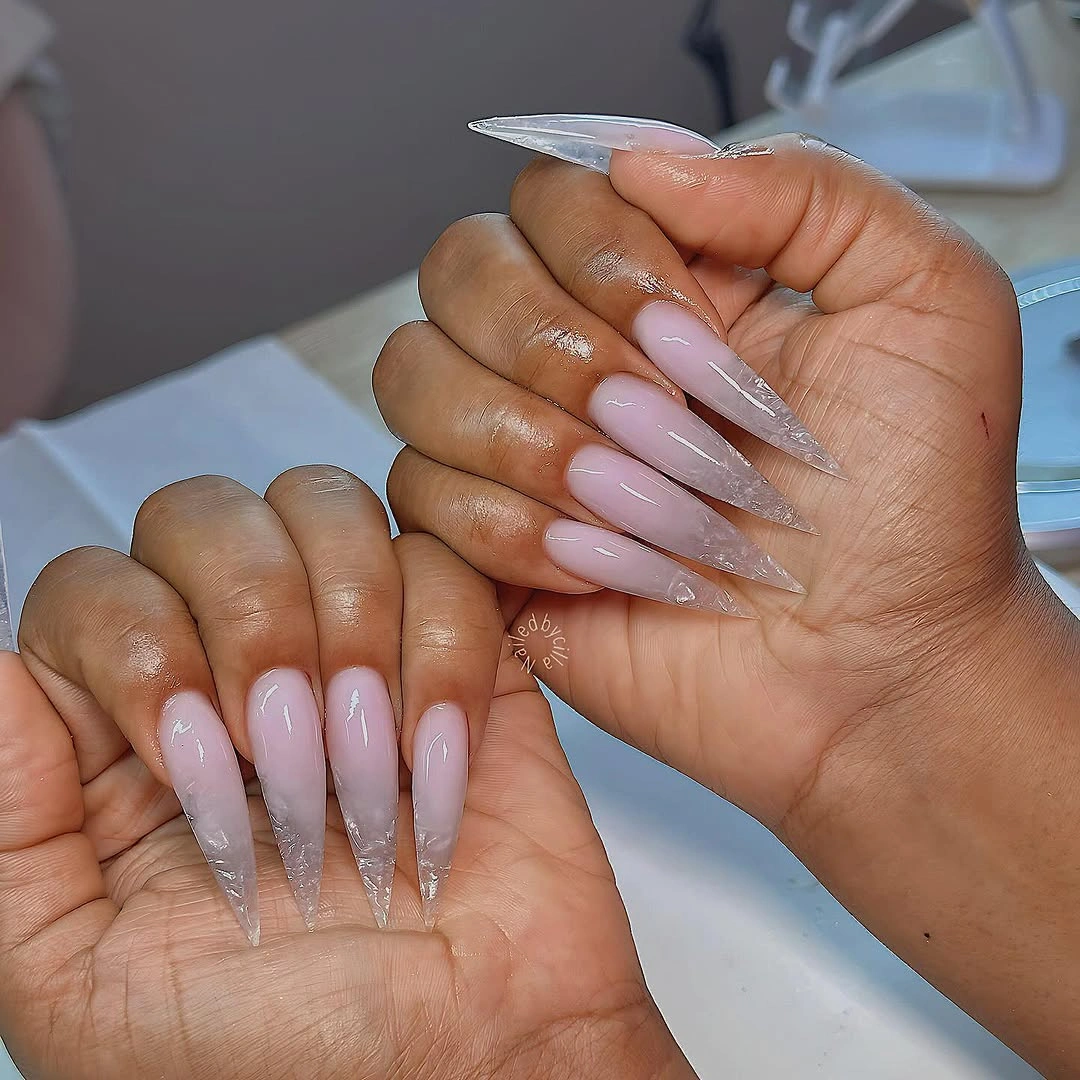
Keep the gradient soft and avoid adding heavy symbols or glitter that would compete with the color movement. A shorter nail can use the same milky base with a smaller lavender edge, but the two tones should still blend rather than meet in a hard stripe. If you prefer a warmer autumn direction, replace the lavender with muted peach while preserving the pale-to-pale shift.
After the floral and jeweled sets, this option creates a useful visual breath while keeping the length statement intact. It is quieter than the jewel-tone design that follows, but the long edge remains a practical commitment even when the palette is gentle. Choose it when you want the manicure to feel finished through color alone and leave the surface uncluttered.
Jewel-Tone Panels on Pointed Nude Nails
Long pointed nails combine nude sections with dark purple, blue, green, and pink jewel-like accents arranged in uneven abstract panels. The neutral spaces prevent the saturated colors from merging, and the repeated point shape gives the asymmetrical palette a shared outline. The eye moves between open base and color rather than following one repeated motif.
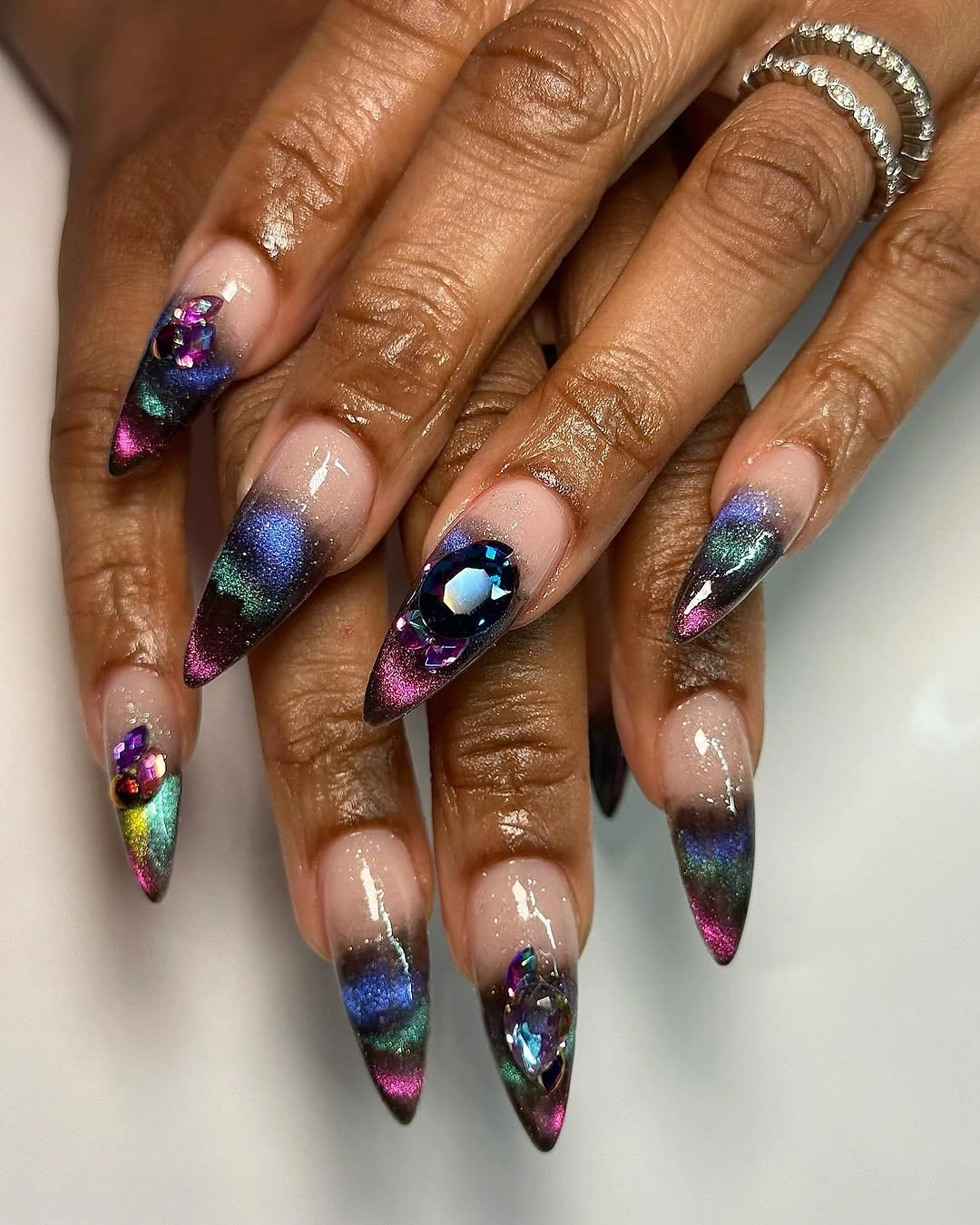
Choose two jewel tones and keep the nude base visible on a shorter nail if you want to retain the same contrast. The original design has energy because the panels are separated, so filling every gap with another dark accent would make the hand look heavier and reduce the sense of negative space. A deep green and berry pairing would keep the palette seasonal without copying every color.
This is more abstract and color-rich than the milky lavender gradient, with a stronger statement and a greater dependence on precise placement. The pointed length adds drama, but the open nude areas make the design easier to understand than a full saturated coat. It fits a reader who enjoys jewel tones but still wants neutral space to control the composition.
Pink Almonds with Bright Yellow French Edges
Medium almond nails use a translucent pink base with bright yellow tips and small green or orange touches on a few edges. The warm yellow creates a clear spark against the softer pink, while the repeated French placement keeps the color from spreading across the whole hand. Because the length is moderate, the manicure feels lively without needing large motifs or extra-long points.
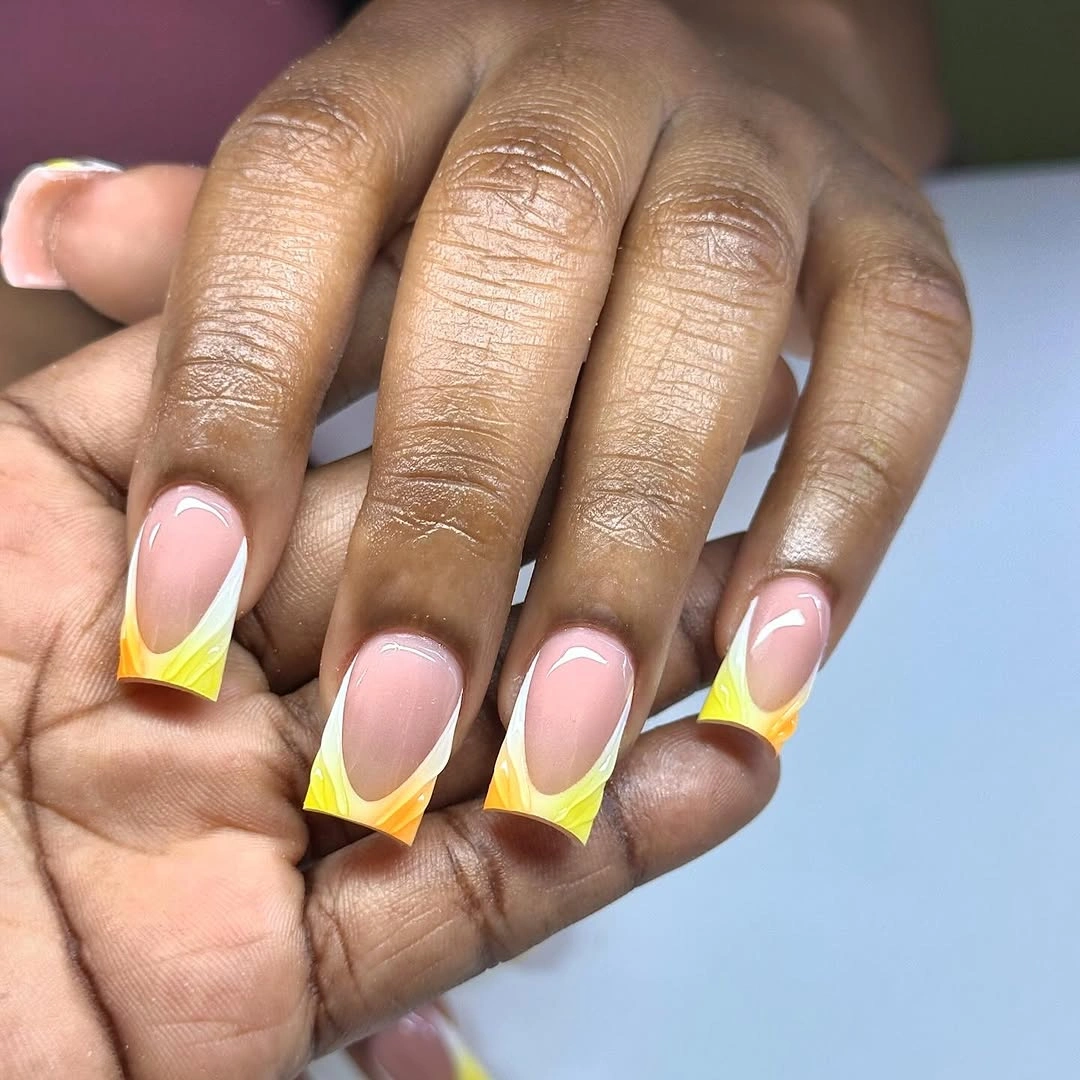
Keep the yellow on the tips and limit the green or orange to tiny accents so the edge remains the main decision. This is a useful shorter adaptation because the color logic does not require much surface area, and a rounded almond can preserve the same upward movement. If neon yellow feels too sharp, a mustard or warm gold tip can soften the contrast without losing the fall direction.
Compared with full floral art, this design is easier to read and more practical to scale down, yet the bright border will reveal growth or uneven tips quickly. It sits between a solid color and a graphic motif, using placement to create interest. Choose it when you want the manicure to feel cheerful and seasonal while keeping the surface mostly open.
Sheer Pink with Coral and Lilac Tips
Medium almond nails use a translucent pink base with soft coral and lilac gathered at the tips, creating a light two-tone edge. The open base keeps the warm tip colors airy, while the repeated placement gives the short-to-medium shape a clear rhythm. It is a quieter color transition than the full orange designs that arrive next.
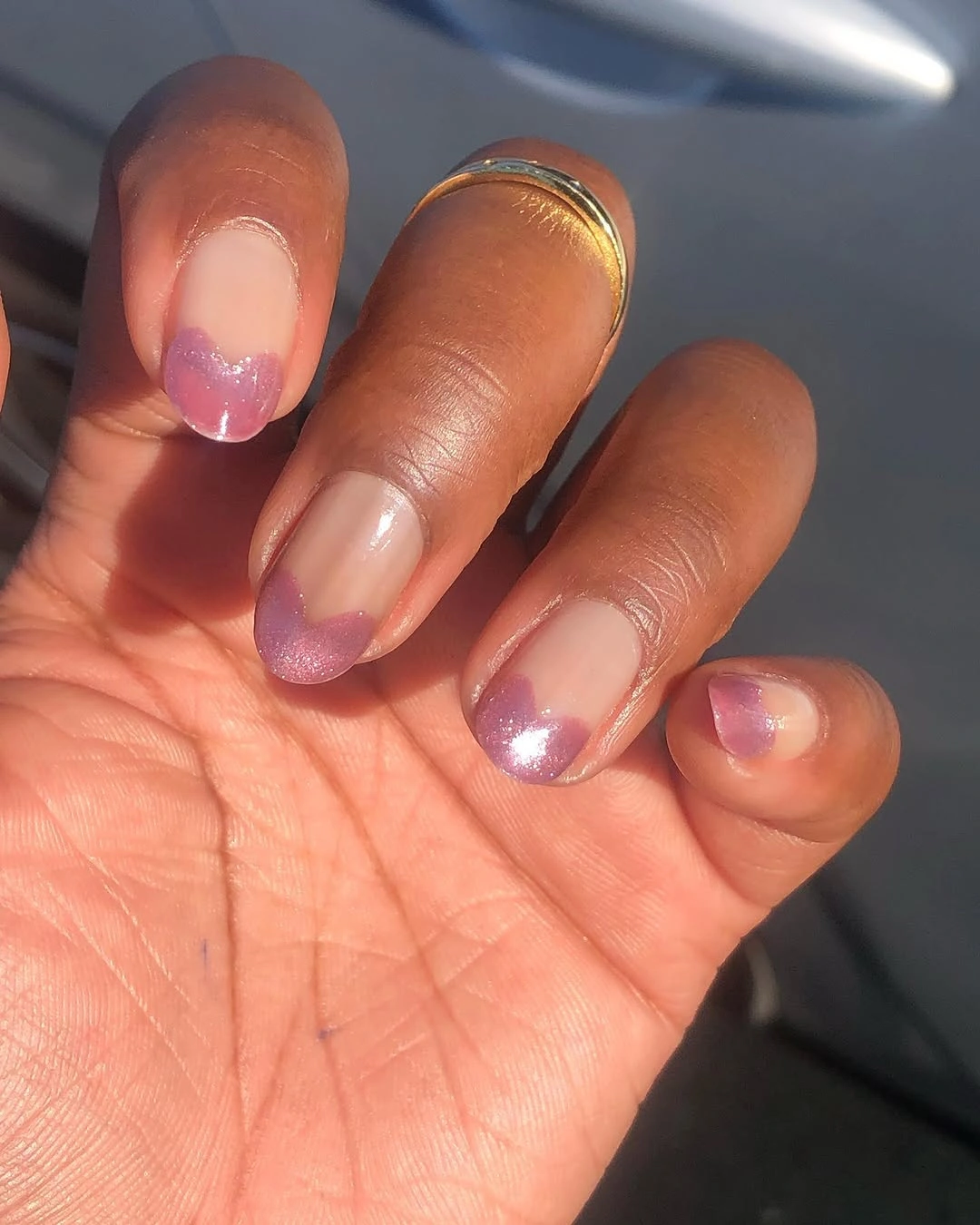
Keep the tip color narrow and use one warm shade with a cooler accent if you want to simplify the idea. Spreading the color over the whole nail would lose the floating effect, while a shorter oval or almond can still show the contrast if the band remains clean. A muted peach can replace the coral when you want less saturation without changing the placement.
This manicure introduces a lighter pause after the jewel-tone and yellow-edge options, and it is easier to scale down because it needs little surface art. The translucent base does make the border between colors important, so uneven tips will change the balance quickly. Choose it when you want fall warmth expressed as a soft edge rather than a solid coat.
Orange Line Art on Compact Square Nails
Short-to-medium square nails use a warm orange base on some fingers and pale neutral bases with flowing white and yellow lines on others. The curved marks repeat the orange family without making every nail identical, so the hand gets movement across a compact shape. The manicure reads as graphic, but the design does not depend on a long point to make its color visible.
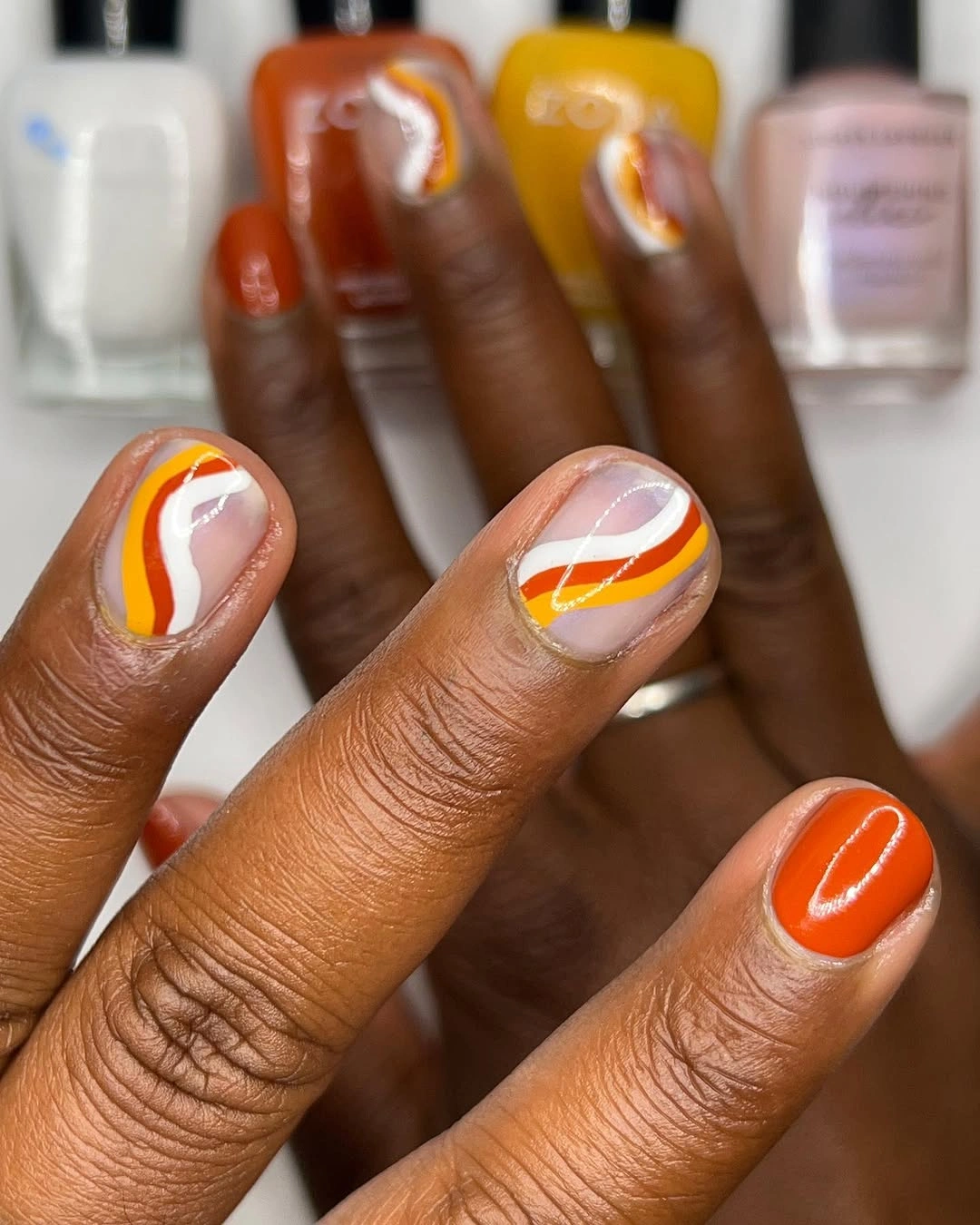
Keep the line art to one or two accent nails and use a single orange shade on the rest when adapting the idea. Shorter surfaces benefit from clear spacing between strokes; if the lines become too numerous, the white and yellow accents will merge into a blur. A cream base can also make the orange feel warmer and keep the composition grounded.
This is less length-dependent than the stiletto sets and more approachable than the jewel-tone panels, though thin lines still need enough room to stay distinct. The tradeoff is precision rather than durability: a small smudge changes the direction of the graphic immediately. It is a practical way to wear fall orange when a full solid coat feels too plain.
Glossy Orange on Medium Oval Nails
Medium oval nails close the collection with a saturated glossy orange and no visible motif, making the color itself the complete decision. The rounded shape keeps the strong warm shade from feeling overly sharp, while the shine gives the single-color surface enough dimension to hold attention. It is a direct, confident finish after the many patterned options.
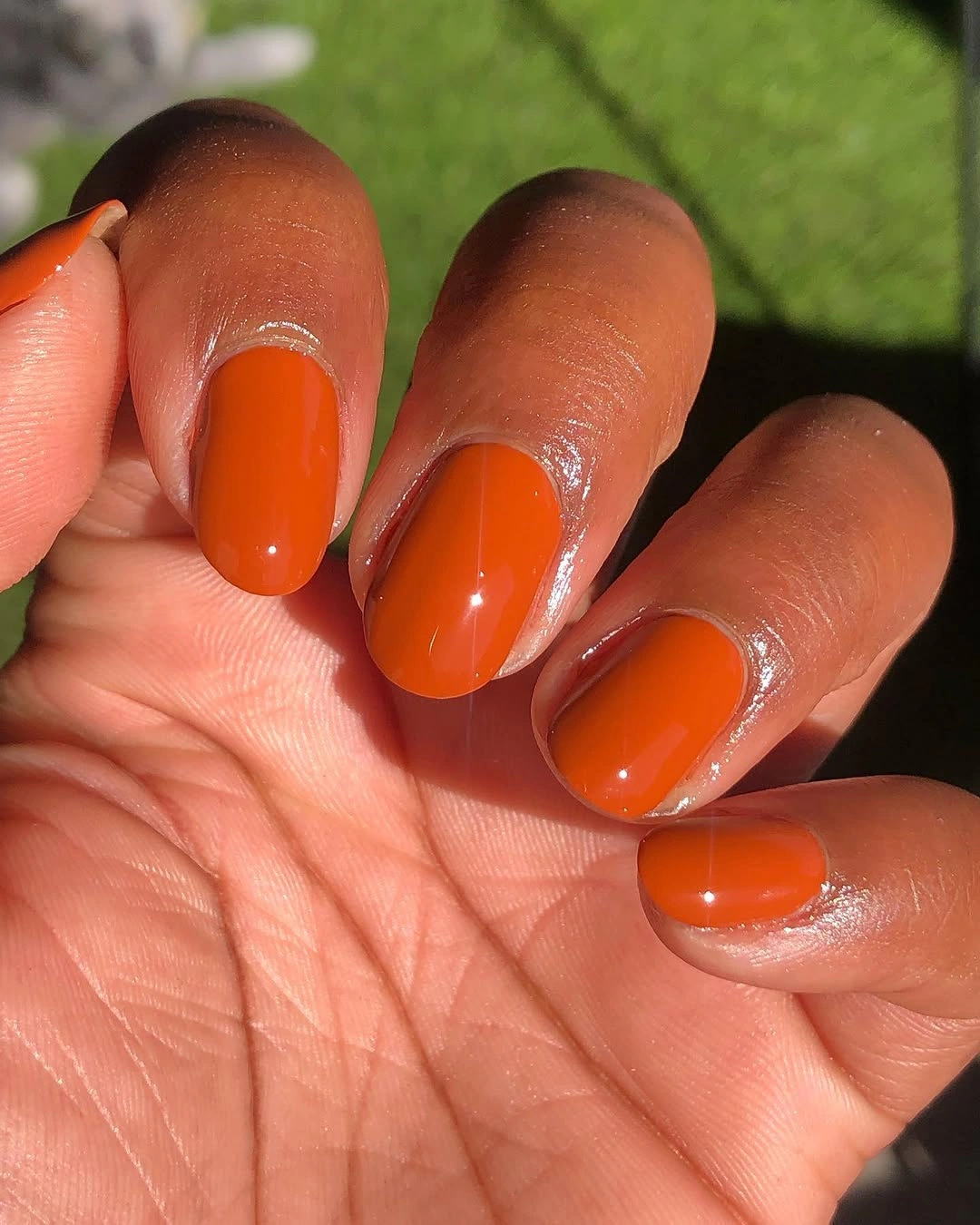
Choose the brightest orange you can wear comfortably and keep the edge rounded if you want the same clean effect at a shorter length. There is no art to hide an uneven border, so the shape and surface need to be consistent across the hand. If saturated orange feels too intense, a burnt or terracotta version can preserve the seasonal warmth while lowering the contrast.
This manicure is simpler than every graphic design before it, but simplicity does not make it visually weak. The single shade gives the eye a clear endpoint and keeps the palette coherent after all the florals, dots, outlines, and gradients. Wear it when the best fall color choice is one strong warm note rather than a collection of competing details.